North India's Hotel Market Is Four Markets, Not One
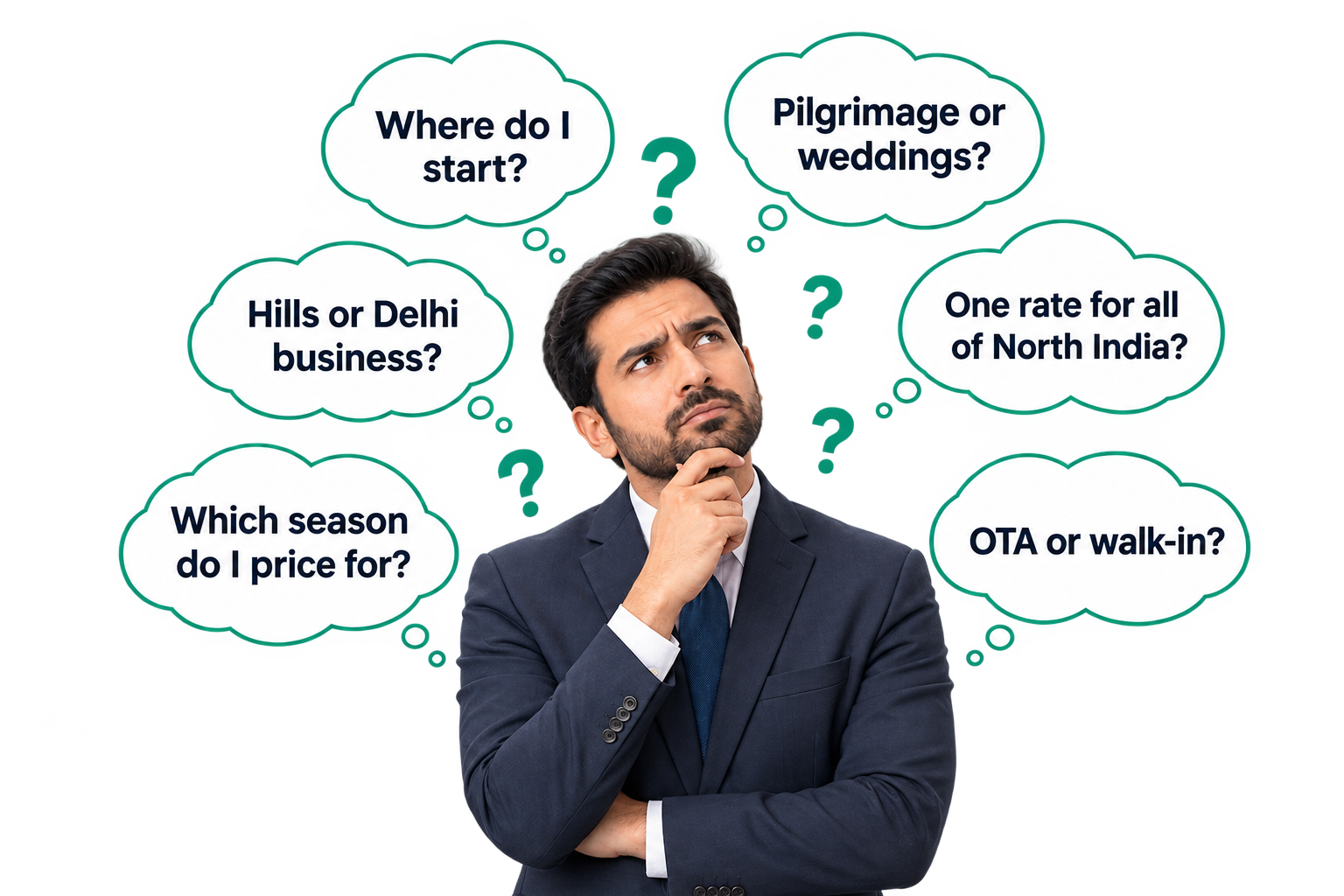
Ask a revenue manager in Rishikesh and another in Gurugram what "North India" means for their rates, and the two answers barely overlap. One is reading a lunar calendar. The other is reading a conference schedule. That gap is the reason this region is split into clusters, and why a single regional average is close to useless for pricing a room.
Nine states and union territories make up the region for hospitality purposes: Uttar Pradesh, Uttarakhand, Punjab, Jammu & Kashmir, Ladakh, Rajasthan, Himachal Pradesh, Delhi-NCR and Chandigarh. Several appear in more than one cluster, Uttarakhand most obviously, because what drives a booking changes by town, not by state line. Char Dham pilgrims and Nainital holidaymakers share a state government and almost nothing else.
| Cluster | Core states/UTs | Primary driver |
|---|---|---|
| Pilgrimage & Spiritual Circuit | Uttar Pradesh, Uttarakhand (Char Dham), Punjab (Amritsar), J&K (Vaishno Devi) | Religious tourism, government infrastructure spend |
| Heritage & Wedding/Luxury Circuit | Rajasthan (Jaipur, Udaipur, Jodhpur), Uttar Pradesh (Lucknow, Agra) | Destination weddings, palace-hotel tourism |
| Hill Station & Leisure/Adventure Circuit | Himachal Pradesh, Uttarakhand (non-pilgrimage), J&K, Ladakh | Weather-dependent leisure, adventure tourism |
| Business & MICE Hub | Delhi-NCR, Chandigarh | Corporate travel, conferences, exhibitions |
One Source, One Year: How North India's Markets Actually Perform
The four numbers above answer four different questions, so they can't be ranked against each other. Hotel performance can. Here are the region's main markets in the same report, for the same year, using market-wide figures where the source publishes them. India's own numbers sit in the first row as the yardstick.
| Market | Cluster | Occupancy, 2025 | Market-wide ADR, 2025 |
|---|---|---|---|
| India | National benchmark | 64% | ₹8,624 |
| Delhi | Business & MICE | 75.3% | ₹11.7k |
| Gurugram | Business & MICE | About 65% | ₹9,633 |
| Agra | Heritage | 70.7% | Not reported |
| Lucknow | Heritage (Uttar Pradesh) | 67.9% | ₹5.6k |
| Jaipur | Heritage | 65.6% | About ₹9.6k |
| Amritsar | Pilgrimage | 59.2% | ₹5.2k |
| Udaipur | Heritage | 54% | ₹15.9k |
| Uttarakhand | Hill and pilgrimage | About 49% | About ₹9k |
| Himachal Pradesh | Hill Station | About 33% | About ₹8.6k |
Look at who beats India's 64%: Delhi, Agra, Lucknow and Jaipur, a business capital and three monument or city markets. The clusters with the most dramatic stories, palace rates in Udaipur, hill-station adventure, pilgrim volume in the hundreds of millions, run at 54%, about a third full in Himachal, and 59% in Amritsar. Varanasi did cross 70% in 2025, which shows pilgrim towns can fill rooms, but volume of people is not the same thing as volume of paid room nights. Price the occupancy you can actually reach, not the footfall that gets quoted.
Pilgrimage & Spiritual Circuit: Volume Without Rate
Uttar Pradesh, Uttarakhand, Punjab and Jammu & Kashmir don't share a border in any consistent sense. They share a trip purpose. Combined annual volume across the circuit runs an estimated 230 million trips, and the 2025 Maha Kumbh at Prayagraj alone drew an estimated 660 million visits in 45 days. Near a shrine or ghat, roughly 70 to 80% of a hotel's bookings arrive as walk-ins, based on our own operating experience, and much of the traffic never touches a branded hotel at all: dharamshalas, ashrams and gurdwara lodging absorb it first.
Rate tells the quieter half of the story. Amritsar ran at 59.2% occupancy and a ₹5.2k ADR in 2025, well under the national line on both. The money here is made by being ready for the guest who walks in, not by chasing a rate premium.

Heritage & Wedding/Luxury Circuit: Rate Without Volume
Rajasthan anchors this cluster, with Uttar Pradesh's Lucknow and Agra a step behind. In 2025 Udaipur's luxury and upper-upscale hotels averaged about ₹25,700 a night against ₹13,379 for the same segment nationally, a premium of about 92%, measured in one data set. They earned it at 54% occupancy, after adding roughly 2.4k rooms since 2019, nearly all of them built for weddings. Jodhpur's luxury ADR crossed ₹22k and Jaipur's was ₹16.2k, so the premium shrinks quickly as you leave Udaipur.
Booking behavior is different too. A wedding is a room block negotiated six to twelve months out through a planner, with minimum spend and cancellation terms that matter as much as the nightly rate.
Hill Station & Leisure/Adventure Circuit: Full Peak Weeks, Thin Years
Himachal Pradesh, the non-pilgrimage hill towns of Uttarakhand, Jammu & Kashmir and Ladakh sell altitude and weather rather than devotion or a wedding date. Two numbers get confused here. One research firm, IMARC, estimates that North India holds about 38.7% of India's adventure tourism market. That is a modeled share of spending, not hotel demand. Himachal's hotels ran at 39.7% occupancy in 2024, against 63.9% for India. A packed weekend in Manali and a thin year can both be true.
Ladakh shows how fast the swing can be: arrivals fell to about 3.36 lakh in 2025 and were up about 50% between January and August 2026, as reported by Reach Ladakh. New roads and tunnels are stretching the season, slowly. The six-months-on, six-months-off pattern is not gone yet.
Business & MICE Hub: The One Cluster That Looks Like a Metro
Delhi sits at the center of a hub that spreads across Gurugram's corporate corridors, Noida and Greater Noida's IT parks and exhibition venues, and Chandigarh running the same playbook at a smaller scale. It is the only North India cluster built on corporate travel and conferences rather than a festival, wedding or leisure calendar. In 2025 Delhi ran at 75.3% occupancy with an ADR of ₹11.7k and RevPAR of ₹8.8k, an ADR about 36% above India's ₹8,624. In 2024 the same comparison gave about 29%, so the gap is widening.
The surprise is inside the city. Delhi's luxury tier earned only about 11% more than the national luxury rate, so most of the premium comes from the upscale middle, not the palaces. Gurugram and Noida carry far more office space than hotel data.
What This Means for a Hotel in North India
Four clusters, four different jobs for a revenue manager. The pilgrimage cluster needs volume-handling discipline and room for the occasional sharp swing. The heritage cluster needs positioning and block-booking discipline more than a pricing calendar. The hill-station cluster needs a seasonal rate structure steep enough to survive a short peak and a long tail. The business hub needs corporate-rate and conference-calendar management, the one job that actually resembles the Tier-1 metro playbook.
| Cluster | What actually needs managing |
|---|---|
| Pilgrimage & Spiritual | Surge capacity for record years and a contingency plan for shock years, since not every town on the circuit swings for the same reason |
| Heritage & Wedding/Luxury | The property's story as a pricing lever; wedding-block terms kept apart from transient rates; occupancy defended alongside ADR |
| Hill Station & Leisure/Adventure | A seasonal rate structure, not a flat annual one; a shoulder-season plan as Ladakh's season lengthens |
| Business & MICE | Corporate contract rates and conference-calendar visibility, standard Tier-1 revenue management |
Pricing a Rishikesh pilgrim property like a Udaipur wedding venue, or running a Shimla hotel on the flat-rate logic that works fine in Gurugram, means pricing against a guest you don't have. The booking window, the price sensitivity and the calendar are different, and sometimes they differ inside the same state.
We'd start by naming which cluster a property really belongs to, by guest and booking window rather than by address, because a hotel in Haridwar or Rishikesh can sit in either of two. Then we'd benchmark it against the right yardstick: occupancy and ADR for its own market, not the regional average. We'd check how much of its demand is walk-in, block or corporate, and set the rate calendar around that mix. And wherever occupancy is the pressure point, in Udaipur, Himachal or Amritsar, we'd defend room nights before chasing the headline rate.
Which North India cluster does your property really belong to?
Book a call and we'll place your hotel against the right comp set, with live results from comparable properties, not a regional average.
Book a Call to See Live ResultsOccupancy and ADR for Delhi, Gurugram, Agra, Lucknow, Jaipur, Amritsar, Udaipur, Uttarakhand and Himachal Pradesh, and the all-India benchmarks (64% occupancy, ₹8,624 ADR, ₹13,379 luxury and upper-upscale ADR), come from Horwath HTL's India Hotel Market Review 2025 (February 2026, CoStar data). Himachal's 39.7% occupancy and the 63.9% national figure are from the 2024 edition (February 2025). Gurugram's 65% occupancy and Jaipur's ₹9.6k ADR are printed chart labels rounded by Horwath HTL, while the Uttarakhand and Himachal 2025 figures are read from the report's bubble chart, so treat them as approximate. Percentage premiums are our own arithmetic on published figures. The 38.7% adventure share and the national adventure market are IMARC Group's 2025 estimates for its own definition of North India. Ladakh arrivals come from Reach Ladakh and Telangana Today. The 660 million Maha Kumbh visits are a state-reported estimate, the 230 million annual trips are our own combined count across major shrine towns, and the 70 to 80% walk-in share is MMR operating experience; we found no independent source for either. Each cluster page sets out its own sources in full. Treat this page as the map, and the cluster pages as the evidence.
Where does your property actually sit against North India's numbers?
Book your free revenue audit with MMR's revenue strategy team, the same team tracking performance across an 843-property national portfolio. We'll benchmark your ADR and occupancy against your real comp set, at no cost.
Book Your Free Revenue Audit Frequently Asked Questions
Want this set up for your property?
We'll review this against your hotel's current setup, free of charge.