
When there's no landmark to fight over
Everyone wants to rank on Booking.com. Everyone wants to show up on the first page of Google. Almost nobody asks whether the name they picked five years ago was ever built to do either of those jobs.
Here's where it actually plays out differently depending on what kind of property you're running, and honestly, most hotel owners have never sat down and worked out which category they fall into.
Take a hotel sitting in New Market, Bhopal. No lake next door. No fort. No waterfall. Nothing a tourist is searching for by name. A property here called something generic, or worse, something aspirational and meaningless, is invisible to a very specific kind of search: the traveller who doesn't know the area and is searching by function instead of landmark. "Hotels near center of city Bhopal" is a real search pattern, and a property that's actually positioned itself around that phrase, in its name, its tagline, its OTA subtitle, catches traffic a property called Grand Regalia Palace never will.
This one's simple, weirdly simple once you see it. No major geographic anchor nearby means you become the anchor. You name yourself after the thing people are actually looking for, which in this case is centrality itself, or proximity to a railway station, or nearness to a specific market or hospital, whatever the actual functional draw of that location happens to be. Small towns and non-tourist markets across Madhya Pradesh, and honestly most of tier-two India, have dozens of properties sitting on exactly this kind of untapped naming opportunity and doing nothing with it.
When everyone's fighting over the same landmark
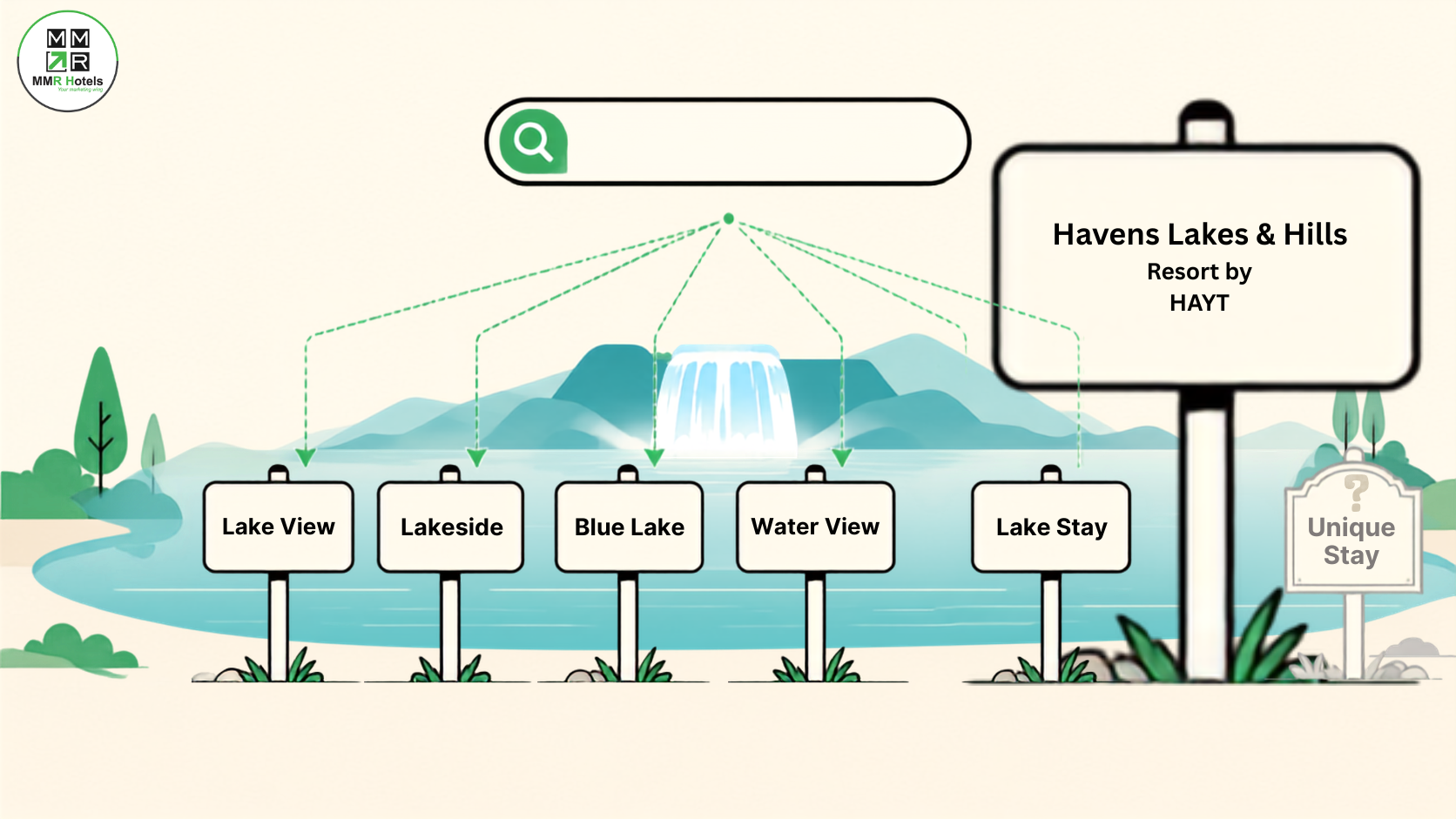
Now flip it. A property sitting directly in front of an actual lake. Say it's called Prince Palace. Meanwhile the competitor set around that same lake includes Lakeview Ashoka, Wind and Waves, Lakeview Retreat. Someone searches "hotels near the lake" on an OTA or on Google, and every single one of those competitors is a near-literal match for what was typed. Prince Palace isn't. It's a beautiful name. It says nothing about where it sits. So it drops, consistently, below properties that are arguably worse hotels but happen to be named correctly for the search.
This shows up around beaches in Goa and coastal Karnataka, around forts in Rajasthan, around waterfalls in the Western Ghats, around basically any natural or historical feature that draws tourism on its own gravitational pull. Once six or seven properties all lean on the same word, they don't just compete for rank, they actively blur into each other for the guest doing the comparing. Nobody remembers which one they actually booked until the confirmation email shows up.
The exception, and why even they hedge
There's one clean exception to all of this, and it's worth naming honestly rather than pretending it doesn't exist. The big international and national chains don't play by this rule, or at least, they don't seem to. A property under a globally recognized chain name, call it Meridian Crest for the sake of not naming anyone specific, dominates a market regardless of what specific words sit in its name, because the parent brand itself is the search term. People search "Meridian Crest Bhopal," not "Lakeview Bhopal."
But look closer and even they're hedging. You'll see "by Meridian Crest," "a Northgate property," tucked into names constantly, a locality or property-type word stacked right next to the parent brand. Even the properties with enough brand equity to skip this game are quietly still playing it. That's a signal worth sitting with for a second, because if a brand with decades of trust and global recognition still bothers to tuck a locality word into its name, that's not decoration. That's a company that ran the numbers and decided the extra visibility was worth the two additional words on a signboard.
Landmark Lookalike Syndrome: the research behind it
I couldn't find a single existing term for this pattern anywhere online, oddly enough for something this common, so I'm calling it Landmark Lookalike Syndrome. What I did find, once I went looking, was research that backs up both sides of it, and it's worth walking through both, because most advice online treats this as an obvious yes or an obvious no, and it's neither.
The case for it
On the side that says name-matching genuinely works: exact match domains, business names or web addresses that contain the literal phrase someone's searching for, have shown real ranking advantages in SEO case studies, in one instance reaching page one of search results within a week despite ten other brands competing on the same phrase (Holistic SEO, exact match domain case study, 2023). That advantage concentrates specifically in low-competition local niches, which describes most tier-two and tier-three Indian markets fairly well. Bhopal, Ujjain, Jodhpur, these are not the same competitive battlefield as Mumbai or Bangalore, and a naming tactic that would get buried in a metro can genuinely work in a smaller market.
And on the branding side, there's decades of consumer research showing meaningful names, ones that describe something real, get evaluated more favorably and get remembered more easily than names that mean nothing at all (Journal of Product & Brand Management, brand name evaluation research building on Klink, 2000). A name that tells a guest something true about the property, its view, its location, its function, isn't just a search-matching trick. It's doing real cognitive work, making the property easier to hold in memory between the search and the booking.
The case against it
On the other side, the risk is just as real. Marketing research on brand distinctiveness has found that recall runs through a completely separate cognitive path than familiarity does, and the more a name resembles its neighbors, the weaker that distinctiveness path gets (Samu and Krishnan, Journal of the Academy of Marketing Science, 2010). One well-cited study went further, arguing that this kind of cosmetic sameness among competing brands can actively hurt consumers, confusing a genuinely good experience with a mediocre one at a look-alike neighbor, which quietly drags down the good property's reputation while propping up the weak one (Warlop, Ratneshwar, and van Osselaer, International Journal of Research in Marketing, 2005).
And Google itself has a documented history here. It specifically targeted low-quality exact-match domains with an algorithm update back in 2012, once the search-quality damage from that tactic became obvious industry-wide. The lesson from that update carries over cleanly to hotel names: a search engine or an OTA algorithm eventually notices when a naming pattern is being gamed rather than genuinely descriptive, and it adjusts.
Why good reviews change the math
Here's the part that actually matters most for a small owner deciding whether any of this is worth the effort. None of it is fatal if the property is genuinely performing. Research on booking behavior has found that when review signal, brand familiarity, and price all compete for attention at once, the review signal wins, consistently outranking brand recognition as the strongest driver of booking intent (Wen, Lin, Liu, Xiao, and Li, Journal of Travel Research, 2021).
And the lift from strong reviews isn't evenly spread either. It's stronger specifically for lesser-known properties, the ones without an existing name advantage, than it is for already-famous ones (Gavilan, Avello, and Martinez-Navarro, consideration-set research on review valence and hotel familiarity). Which means a genuinely five-star, review-heavy small hotel can survive a mismatched or generic name just fine. Guests will find it through the reviews regardless of what the name is doing or not doing, because at that point word of mouth, star ratings, and review volume are doing the discovery work that the name was supposed to help with.
But that's a survival case, not an optimization case. If the reviews are already excellent, aligning the name to the geography or the view doesn't rescue anything, because nothing needed rescuing. It multiplies. It's additional visibility stacked on top of a property that was already going to convert once someone found it, which is exactly why the big chains keep doing the locality-modifier trick even though their brand name alone would carry them regardless. They don't need it. They do it anyway, because it's free additional capture sitting on the table, and leaving it there just means a competitor picks it up instead.
So which side wins. Neither, is the honest answer, and treating this as a binary choice is where most advice online goes wrong.
The actual fix
The fix isn't picking landmark-naming or brand-naming. It's separating the two jobs the name was trying to do at once. Keep one fixed, protected brand identity, Ashoka, say, across every property in a chain, so equity never dilutes and a guest who had a great stay at one location trusts the next one on sight. Then let the landmark ride underneath it as a modifier, not a replacement: Ashoka Lake View, Ashoka Windfalls. The brand does the trust work. The modifier does the search-matching work. Neither job cannibalizes the other.
For a single independent property with no chain structure behind it at all, the same logic still applies, just with one name instead of a family of them. If Prince Palace genuinely sits on the lake, the fix probably isn't dropping Prince Palace entirely. It's adding the modifier next to it rather than instead of it: Prince Palace Lakeview, or Prince Palace by the Lake. The identity stays intact for anyone who already knows the property, and the search-matching layer gets added for everyone who doesn't yet.
Geography does more work than the name does
The part people miss is that OTA discovery doesn't actually run purely on the property name field the way everyone assumes. It runs heavily on geography and locality tagging, the coordinates pinned to your listing, the locality field filled out correctly, which is exactly how a correctly tagged Ashoka Lake View still surfaces for a "hotels near the lake" search regardless of whether the word "lake" sits inside the name itself.
- 1Get the coordinates rightThe map pin, not just the address text, decides whether you surface for nearby-landmark searches.
- 2Fill the locality field properlyThis is doing more of the heavy lifting than the name-matching crowd wants to admit.
- 3Use the subtitle or tagline fieldWhere the platform offers one, this recovers most of what a mismatched name leaves on the table.
Parity by geography is doing more of the heavy lifting than the name-matching crowd wants to admit. The name still matters, particularly for the smaller slice of typed, exact-phrase searches and for whatever residual weight OTAs give the name field directly, which is where a subtitle or tagline field, when the platform offers one, recovers most of what's left. Get the coordinates right, get the locality field right, get the Google Business Profile category right, and a fair amount of this problem solves itself before the name even enters the conversation. The name is the finishing touch, not the whole mechanism.
What to actually check
None of this needs a rebrand. For a small independent, one or two properties, no chain backing, the honest advice is simpler than the whole study list makes it sound: if reviews are already strong, the name isn't going to sink you, but aligning it to the geography or the view is still free money sitting on the table. If reviews aren't strong yet, the name matters more, not less, because it's one of the few visibility levers a small property controls entirely on its own, no algorithm update required, no ad spend required.
Either way it's worth an honest look at what's actually sitting in the property name, the OTA subtitle, and the locality tag, and whether all three are pointed at the same thing or working against each other without anyone noticing. Pull up your OTA listing right now, actually look at the name field, the subtitle field if one exists, and the map pin. Three fields, five minutes, and most owners have never done it even once since the property opened.
Sources referenced above: Holistic SEO exact-match domain case study (2023); brand name evaluation research in the Journal of Product & Brand Management, building on Klink (2000); Samu and Krishnan, Journal of the Academy of Marketing Science (2010); Warlop, Ratneshwar, and van Osselaer, International Journal of Research in Marketing (2005); Wen, Lin, Liu, Xiao, and Li, Journal of Travel Research (2021); Gavilan, Avello, and Martinez-Navarro, consideration-set research on hotel review valence and familiarity.