Why Your Hotel's Reputation Is a Revenue Lever
Before booking, most travellers check reviews across two or three platforms. A strong score opens the door. A weak one closes it before the property gets a chance to make its case.
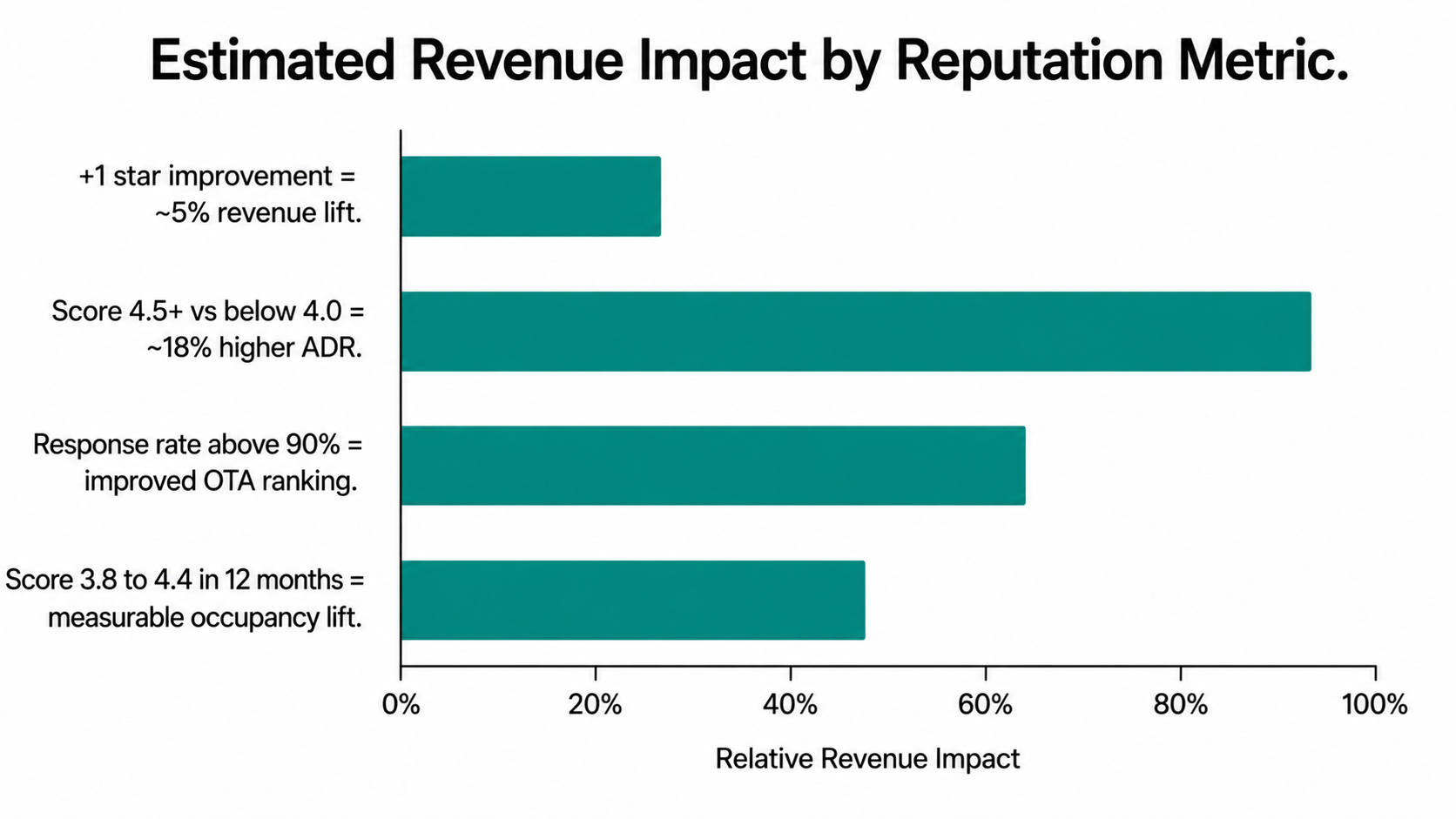
The impact goes deeper than just bookings. OTA algorithms on Booking.com, Expedia, and MakeMyTrip factor review scores directly into search ranking. A property at 4.5 with 300 reviews ranks above one at 3.8 with 500 reviews, even with competitive pricing. That ranking gap shows up as visibility, clicks, and revenue, with no extra marketing spend involved.
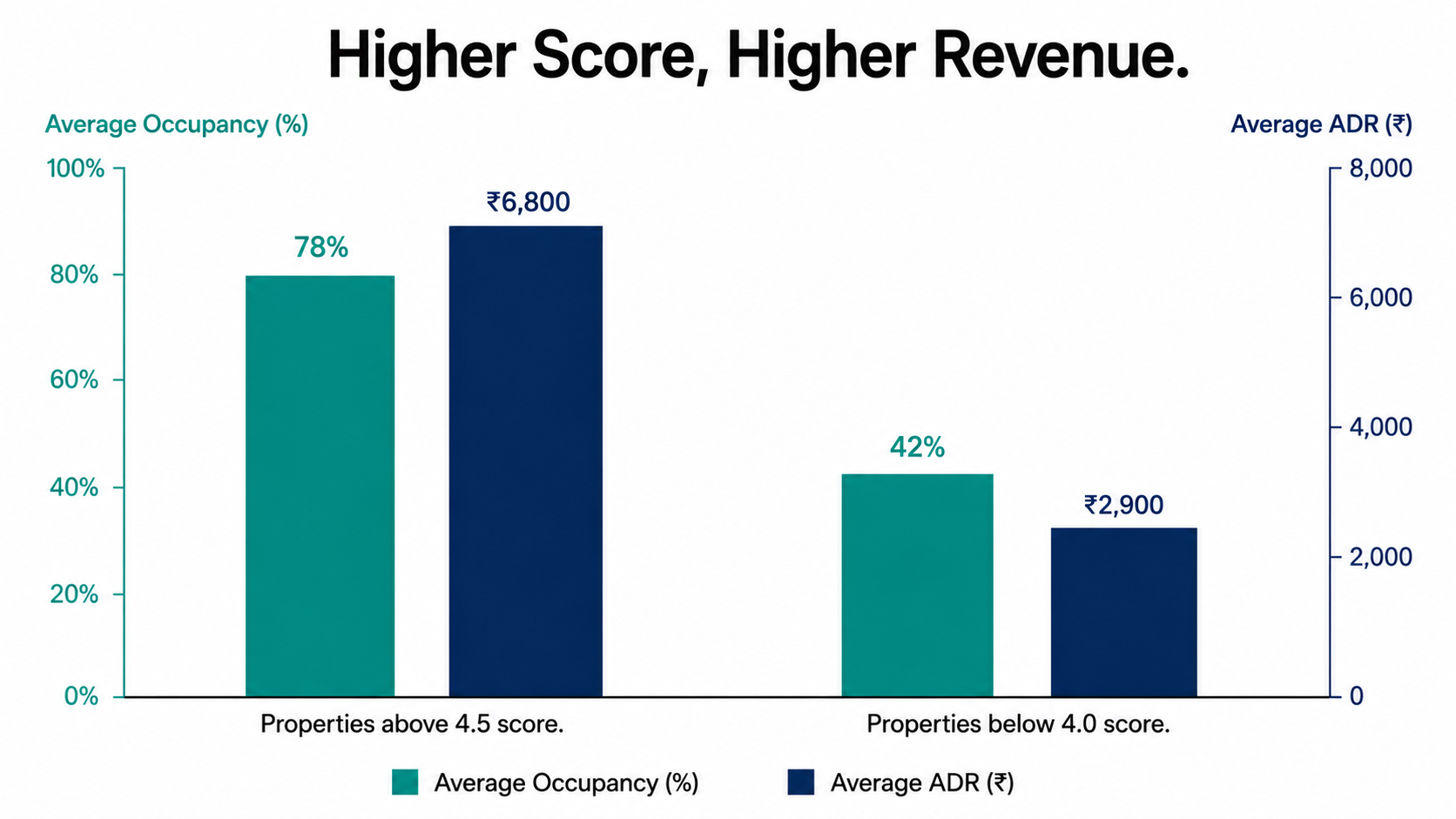
A one-star improvement in review score correlates to roughly 5 percent more revenue. Properties above 4.5 consistently outperform comparable properties below 4.0 on both occupancy and ADR in the same location.
Review scores also affect what a property can charge. A strong, consistent reputation holds pricing power during high-demand periods, guests pay the premium because the score justifies it. Weak or inconsistent scores push a property into competing on price by default, which compresses margins and pulls in a different kind of guest.
Direct bookings follow reputation too. A guest who finds a hotel on an OTA and sees poor reviews won't book anywhere on that property. A guest who sees strong reviews will often search for the website directly to skip the OTA fee.
| Score | Approximate Ranking Impact |
|---|---|
| 4.5 and above | Top 20% ranking |
| 4.0 to 4.4 | Mid-tier visibility |
| 3.5 to 3.9 | Below-average ranking |
| Below 3.5 | Near-invisible on OTAs |
Reputation isn't a marketing function sitting off to the side. It touches ranking, pricing power, occupancy, and direct booking conversion all at once.
Reputation touches ranking, pricing, and direct bookings all at once. Most hotels aren't losing on any of these because of bad service. They're losing because of something more avoidable than that.
Common Reputation Challenges at Independent Hotels
Most independent hotels in India are not losing guests because of genuinely bad service. They're losing them because of how feedback gets handled, or more accurately, doesn't get handled at all.
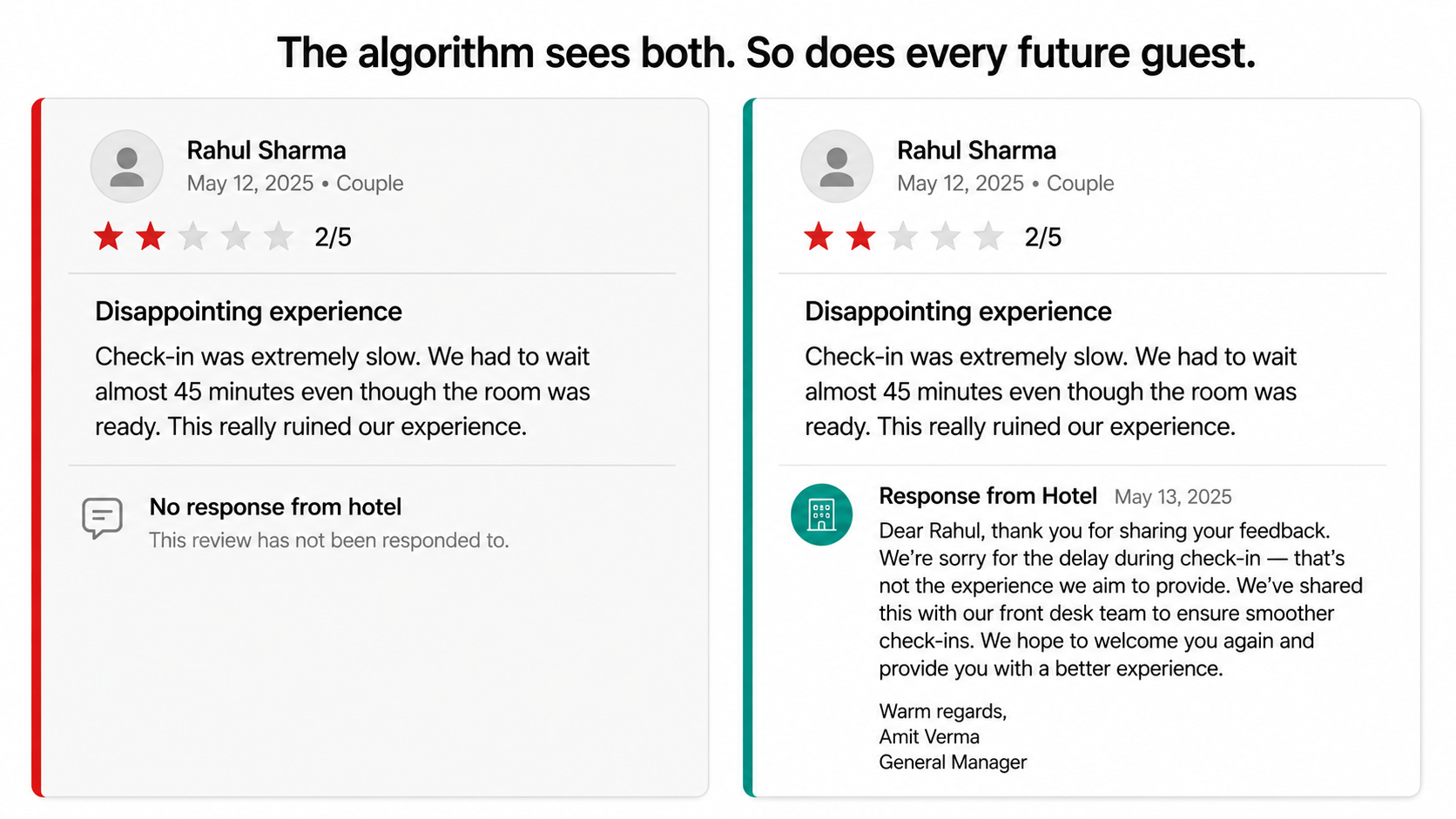
Negative reviews sit unanswered for days, sometimes weeks. When a reply finally shows up, it's generic, defensive, or clearly copy-pasted from a template that's been reused fifty times before. Both the next guest reading it and the OTA algorithm scoring it pick up on the same thing: guest communication isn't a priority here.
Guest communication after checkout is almost nonexistent at most properties. Contact details get collected at check-in and then nothing happens with them. The guest leaves, has whatever experience they're going to have, and the hotel finds out only if it shows up as a public review. By then the damage is done and what's left is damage control.
Response rates run low across most independent properties, and OTA platforms factor that into their ranking. A property answering fewer than half its reviews is telling the algorithm, in effect, that it doesn't prioritise guests talking back to it. That signal has real consequences in visibility, and eventually in revenue.
Service also tends to drift without anyone noticing. Front desk experience varies depending on who's working that shift. Housekeeping quality shifts day to day. None of this gets tracked through feedback in a structured way, so management has no reliable signal to spot the pattern or fix whatever's actually causing it. A reputation doesn't usually fall apart from one disaster. It erodes through a string of small things, accumulating quietly. A 4.2 becomes a 3.9 over a few months and nobody clocks it until the booking numbers start sliding.
None of this requires a disaster to happen. It just requires nobody to be watching closely enough, which is exactly the gap the next part is built to close.
The MMR Reputation Management Framework
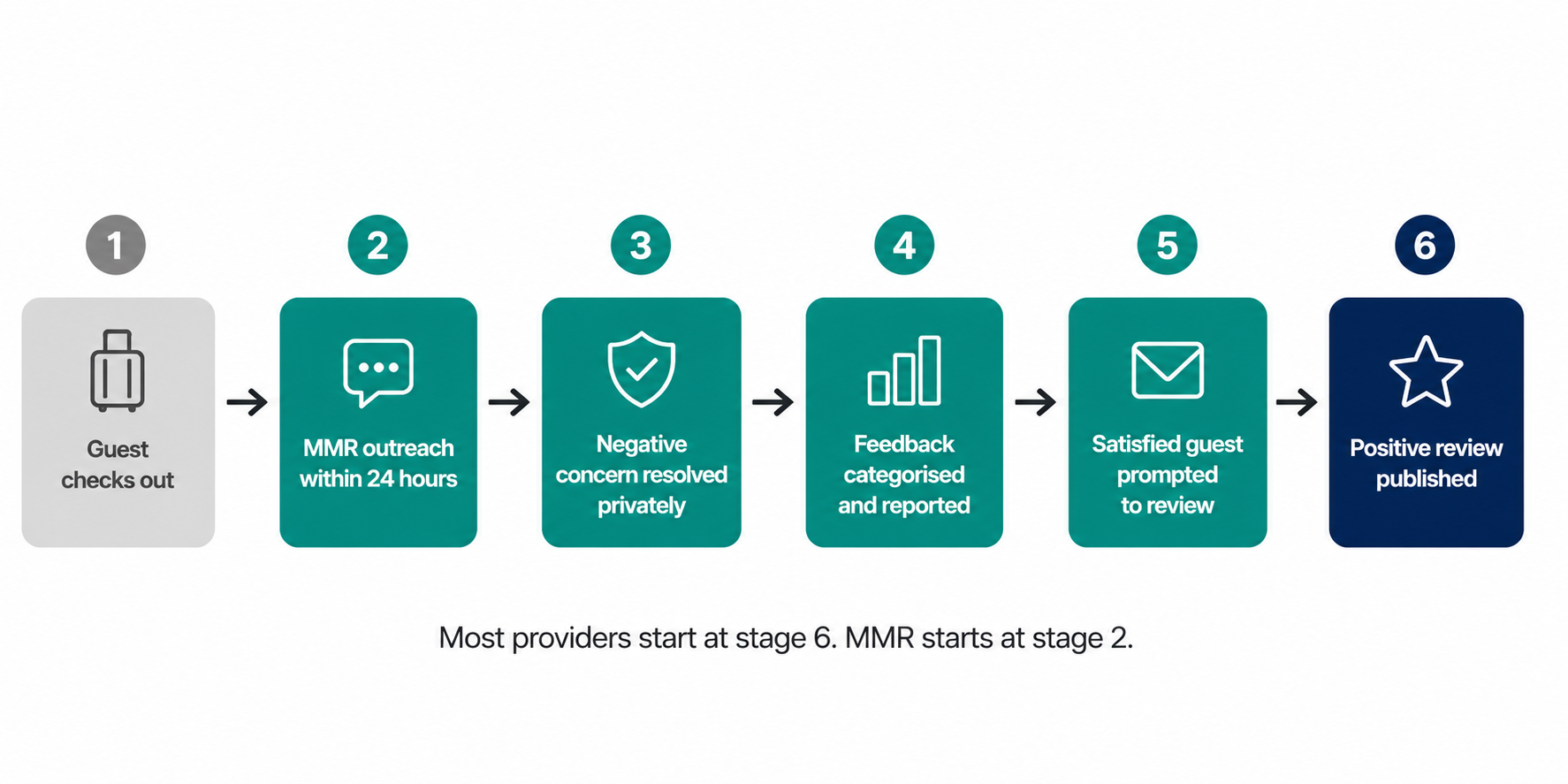
Most reputation management providers focus on one thing: responding to reviews after they go live. MMR works earlier than that. We manage the guest experience before it ever turns into a review, which means fewer negative ones land in the first place, and the feedback that does come in pushes scores up instead of down.
Five steps make up the framework, and each one feeds into the next.
| Step | What Happens |
|---|---|
| 1 | Proactive outreach after every stay, before the review gets written |
| 2 | Private resolution of concerns before they go public |
| 3 | Feedback patterns turned into operational fixes |
| 4 | Satisfied guests prompted, at the right moment, to share their experience |
| 5 | Review management running across every platform guests actually use |
Reaching Out Before the Review Gets Written
After every stay, our team contacts guests who booked through OTAs and other online channels to find out, directly, how things actually went. Not a mass email blast. A real, personal outreach built to catch honest feedback before the guest decides what they're going to post publicly.
There's a practical reason this matters. Most negative reviews come from guests who felt unheard, not guests who had a genuinely terrible stay. Reach them first, in private, and the dynamic changes before it ever reaches a public platform.
Resolving Problems Before They Go Public
When a guest flags a concern, the team moves fast. Depending on what happened, that might mean a personal call, a direct apology from someone at the property, a service recovery gesture, or a voucher toward a future stay.
A guest who feels heard rarely writes a bad review. A guest who feels brushed off almost always does. The point of service recovery isn't to stop reviews from happening. It's to show the guest someone actually cared about what went wrong, and that shifts how they feel about the whole stay, not just the one issue.
Turning Feedback Into Operational Fixes
Every guest interaction produces a small piece of data. Recurring themes get pulled out and shared with hotel management as something specific to act on, not a vague summary nobody reads.
Housekeeping complaints showing up three weeks running aren't a coincidence. A pattern of late check-ins isn't bad luck either. Once feedback gets structured this way, individual comments stop being noise and start functioning as actual operational intelligence.
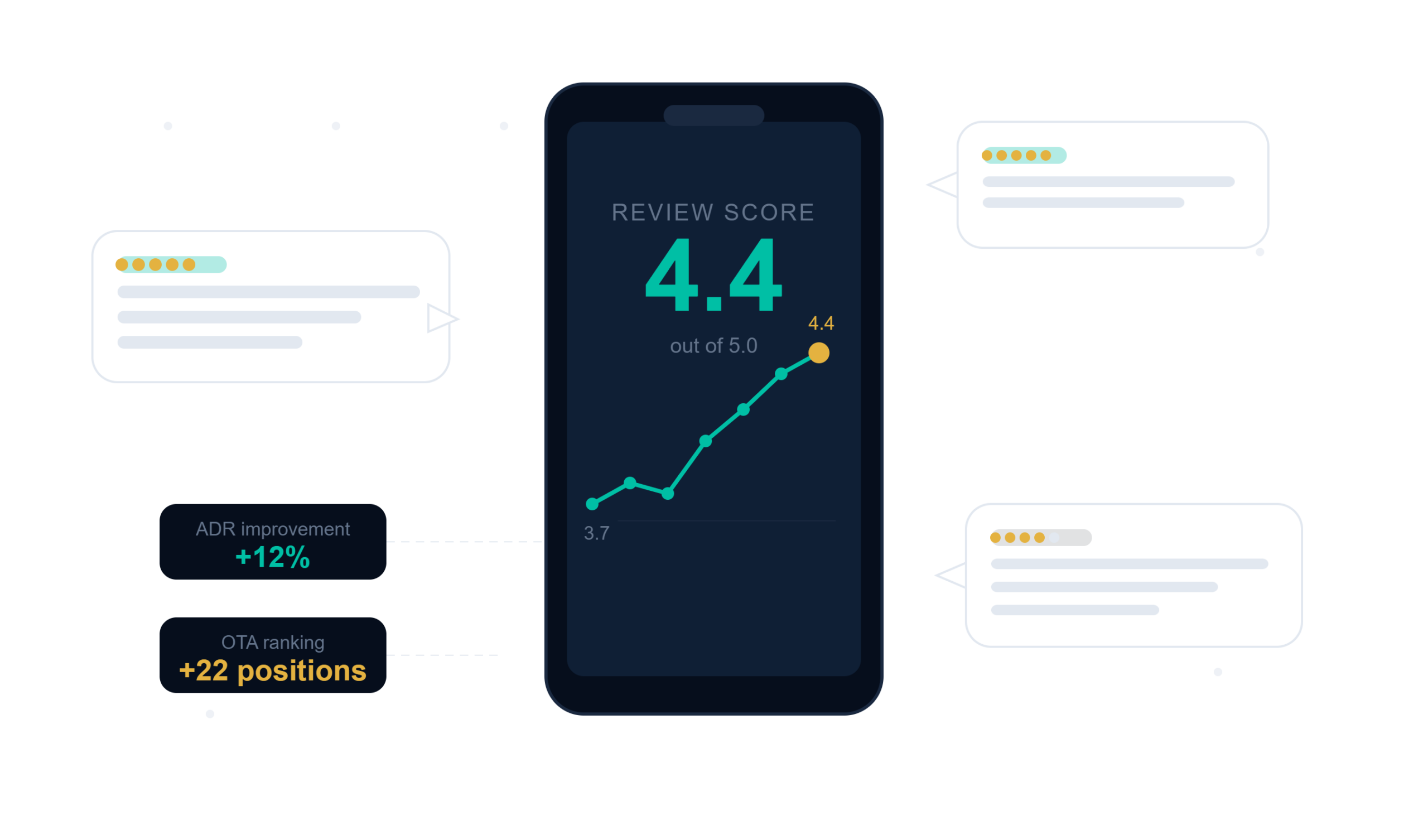
Sitting at 3.7 on Booking.com, a 40 percent response rate, no post-stay outreach of any kind.
Proactive outreach went live, 11 private complaints resolved in the first 60 days, response rate climbed to 94 percent, and a recurring housekeeping issue affecting roughly 30 percent of stays got flagged and fixed.
Score moved from 3.7 to 4.3 in 90 days. Booking.com ranking climbed 22 positions in the city category. ADR was up 12 percent over the following quarter.
Encouraging Guests Who Actually Had a Good Stay
Happy guests are usually wasted potential. Most hotels do nothing to get them talking, recommending, or coming back. We build that step in deliberately, a well-timed, genuine prompt sent to guests who had a positive stay, pointed toward whichever platform actually matters for where they booked.
Building a Reputation That Holds
The first four steps compound into this last one. More positive reviews. Fewer complaints turning into public ones. Operational fixes chipping away at whatever was causing the recurring problems. Guests coming back and bringing friends. What comes out the other end is a review profile that keeps improving on its own, stronger rankings on the platforms that matter, and a reputation doing real work instead of something that just needs managing.
That's the framework end to end. Where it actually plays out differs by platform, since each one runs on its own logic.
Platforms We Manage
Each review platform runs its own algorithm, weighs things differently, and pulls in a different kind of guest. Treating them all the same way misses what actually moves the needle on each one.
| Platform | Who's There | What Affects Ranking |
|---|---|---|
| All travellers, especially direct bookers | Score, volume, recency, response rate | |
| Booking.com | Domestic and international | Score, response rate, response time |
| MakeMyTrip | Domestic Indian travellers | Score, review volume, recent trend |
| TripAdvisor | International, long-haul | Popularity index, recency, response rate |
| Expedia | International | Score, response rate, content quality |
| Agoda | Southeast Asia and domestic India | Score, sentiment, response time |
| Airbnb | Lifestyle and experience travellers | Response rate, review reciprocity, timing |
Google affects local search and matters most to guests who are going to book direct anyway. MakeMyTrip is the workhorse for domestic bookings, and its score feeds straight into ranking. TripAdvisor's category position still shapes organic visibility for long-haul international guests, even with everything else that's changed in how people search.
Knowing where guests are looking is one half of this. What a stronger reputation is actually worth in revenue is the other.
How Reputation Management Improves Revenue
The link between reputation and revenue is direct, it's measurable, and most independent hotel owners still underestimate it by a wide margin.
Higher review scores mean better OTA ranking, which means more impressions, which means more bookings without spending an extra rupee on marketing. That's revenue growth that comes entirely from how the property reads online.
There's also pricing power involved. A property sitting at 4.6 on Booking.com has more room to move on rate than one stuck at 3.9 in the same neighbourhood. Guests booking the higher-rated property are less sensitive to price, because the score is doing the convincing for you. Over time that shows up directly in ADR.
A guest who had a good stay and felt the hotel actually cared about their feedback comes back at a noticeably higher rate. Repeat bookings carry no OTA commission and no acquisition cost. Built up over a few stay cycles, that compounds into something real.
Reputation pulls direct bookings too, in a roundabout way. A guest sees strong reviews on an OTA and goes looking for the hotel's own website instead, to skip the commission fee built into the rate. Reputation done well chips away at OTA dependency gradually, not through ad spend, just through making the property worth choosing directly.
The numbers explain why this matters. What it actually looks like, day to day, is a different question.
Our Reputation Management Services
Each piece below covers a specific part of the reputation problem. For most properties they all run together as one ongoing engagement, not separate add-ons picked one at a time.
Guest Review Management. Monitoring, responding to, and managing reviews across every platform a property is on. Response rate, the quality of what gets written, and how fast it goes up all feed into ranking.
OTA-Specific Strategy. A different approach for Booking.com versus Expedia versus MakeMyTrip versus Agoda, not one template stretched across all four. What works on one platform doesn't automatically translate to the next.
Google Review Management. Watching the property's Google profile, replying to every review, and pushing the overall score up to support local search visibility.
Guest Feedback Analysis. Pulling feedback together across channels and sorting it into patterns. Recurring themes, service gaps, satisfaction trends, reported back monthly in a form someone can actually act on.
Service Recovery. Handling the full arc when something goes wrong, from the first outreach through to actual resolution.
Reputation Reporting. Monthly reports covering scores, response rates, where the property sits on each platform, sentiment shifts, and what to do operationally about all of it.
That's what's covered, piece by piece. The harder thing to explain is why we approach it differently than most providers do.
Why Hotels Choose MMR for Reputation Management
Most reputation providers start at the review. We start at the guest.
By the time a review goes live, the experience is already finished. What decides whether it's a good one or a bad one happened during the stay, and in the 48 hours right after checkout. That's the window we actually operate in, not the one after the fact.
Proactive outreach means we're already talking to a guest before they've decided what to say in public. That conversation changes the outcome. Managing reviews after they're published is maintenance. We're trying to build something that holds up longer than that.
The feedback loop runs both ways too. Hotels working with us don't just see their scores improve, they get a clearer picture of what's actually driving the service issues underneath those scores. A guest comment stops being a one-off complaint and starts shaping how a shift gets run.
We only work with hotels. Not restaurants, not retail, not hospitality in general. The guest journey, the OTA mechanics, how review platforms actually behave, all of it is specific enough to hotels that a generic approach misses things that matter. This is the only thing the team does, which is why the context doesn't get lost.
Every engagement gets a dedicated person who knows the property, tracks its scores, and reports straight to whoever's managing it. Not a shared inbox somewhere. Not a bot replying to reviews on autopilot. Someone who's actually accountable for what happens.
All Guides in This Pillar
Each guide covers a specific area in depth. Start with the ones most relevant to your current situation.