What is Hotel Revenue Management?
Hotel revenue management is making sure your hotel earns what it deserves.
Your hotel has a fixed number of rooms. The room you don't sell today you will never be able to sell tomorrow. That opportunity is gone forever. You cannot recover that loss. Not next week, not next month. It's done. So the goal has always been this: sell every room at the best possible rate, to the right guest, at the right time.
That definition is old. And it still holds. But these days it is not enough on its own.
Before OTAs existed, guests called hotels directly or walked in. The hotel controlled the full journey from discovery to booking. That is no longer true. Today most hotel bookings in India happen through online platforms. The hotel is no longer the starting point.
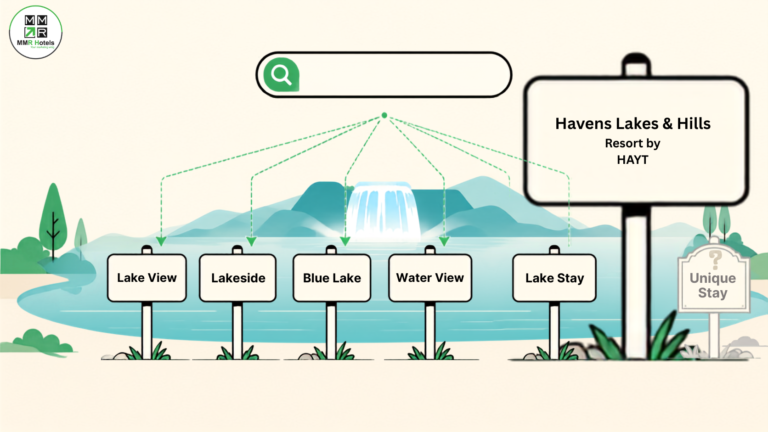
A guest today doesn't call your hotel directly. They open MakeMyTrip or Booking.com, search for hotels in your city, and book from what shows up. Which means before price even enters the picture, your hotel has to be visible. It has to show up. It has to look good enough that they choose you over the five properties sitting next to you on that screen.
A property with sharp pricing, good rooms and decent reviews can still sit empty because its OTA listing is on page three. Guests never reach it. The rate was never the problem. Being found was. Most hotels discover this six weeks after the damage is already done.
So today hotel revenue management is not just about price. It now includes visibility, listing quality, reputation, and which platforms you are selling on.
MakeMyTrip, Goibibo, Booking.com, Agoda, EaseMyTrip. Each has a different audience, different commission structure, and different ranking algorithm. Being on the right ones and managing them correctly is part of revenue management now. Not an afterthought.
Knowing what hotel revenue management is and knowing how to actually run it are two different things. Here is the sequence that makes it work.
How Hotel Revenue Management Works
Most hotels start with price. Wrong place to start.
There is a sequence. Get it wrong and even sharp pricing won't save you.
Step 1: Distribution and Guest Segmentation
Most hotels pick platforms first and figure out the guest later. That is backwards.
Which Platforms Should Your Hotel Be On
A business traveller in Pune books differently than a family heading to Ranthambore for a safari weekend. Different behaviour, different price sensitivity, different booking window. A heritage property guest in Rajasthan is not the same person booking a budget room near a highway. Getting this wrong means spending commission on channels that bring the wrong guest at the wrong price.
MakeMyTrip and Goibibo are where most domestic Indian bookings land. Booking.com pulls a different crowd entirely, more metro, more international. Agoda skews toward certain corridors. The commission structures are different, the ranking logic is different, and what works on one platform doesn't automatically transfer to another.
What Does Distribution Actually Cost
Every OTA booking comes with a commission. Usually 15 to 22 percent depending on the platform. On Rs. 1 crore in room revenue at 70 percent OTA share and 20 percent average commission, that is Rs. 14 lakh going out every year just in distribution cost. Your own website charges nothing. WhatsApp bookings charge nothing. Managing the mix is how you protect margin without losing reach.
Step 2: Listing Quality
Being listed is not enough. Your listing has to be good enough that someone who finds it actually clicks.
What a Complete Listing Looks Like
Professional photos of every room type, common areas, exterior. Minimum 25 to 30 images. Every amenity field filled. Room descriptions that tell a guest what they are actually getting, not "comfortable and spacious." Clear cancellation and check-in policies. A property overview that answers basic questions before a guest has to ask.
Most hotel listings in India are still not doing this. Four photos from 2021. Amenity section half empty. That listing loses to a competitor with complete information every time, even if the actual property is better.
Why Incomplete Listings Lose Bookings
OTA algorithms use listing completeness as a ranking signal. Incomplete listing ranks lower. Lower ranking means fewer impressions. Fewer impressions means fewer bookings regardless of how good the property is.
A guest on their phone comparing hotels in two minutes will not stop to imagine what your hotel looks like. They move to the next one.
Uploading photos once and never updating them. Guests who visited after a renovation see old photos and either do not book or arrive with wrong expectations. Both hurt revenue. Listing photos should be reviewed every six months at minimum.
Step 3: Visibility and Competitive Analysis
Good listing gets you ranked. Visibility is about pushing that ranking higher so more people find you before they find someone else.
How OTA Ranking Works
OTA ranking responds to review score, listing completeness, booking conversion rate, response rate, pricing competitiveness relative to the comp set, and promotional participation. No single signal gets you to page one. All of them together do.
Ranking is not permanent. A hotel on page one today can be on page three in three months if these signals are being ignored.
Why Competitive Analysis Matters
Knowing your comp set is not about copying them. It is about avoiding pricing blind.
If the hotel two streets over drops rates on a Wednesday and you don't know why, you are reacting without context. That is how you make the wrong call confidently. Monitoring your competition daily tells you when to hold, when to move, and when the market is doing something you shouldn't follow.
Moving from position 6 to position 3 on an OTA results page can increase traffic dramatically without changing rates at all. Most hotels spend time on pricing. The bigger opportunity is often one step earlier.
Step 4: Pricing and Demand Forecasting
Guests are finding you. Your listing is converting. Now price correctly.
But pricing without knowing what demand looks like for that date is guessing. That is where demand forecasting comes in.
Hotel Demand Forecasting
Forecasting is not complicated. It is just the habit of looking ahead before making a rate decision instead of reacting after the fact.
Check your pickup data before anything else. How many bookings have come in for next weekend compared to the same period last month? If the pace is faster, demand is building and rates can move up. If it is slower, find out why before dropping anything. A quiet Tuesday in March and a quiet Tuesday before a local festival weekend are completely different situations requiring completely different responses.
What you are looking at: remaining inventory for the date, how fast bookings are arriving, what the comp set is showing, local events and holidays, corporate travel patterns for the corridor if relevant. Some of this changes daily. Some of it, your location, your property type, your target segment, never changes and anchors every other decision.
Every property needs three rates built around this. A floor rate based on actual cost per occupied room. A standard rate for normal demand. A peak rate for dates where demand is confirmed and you know the rooms will fill regardless.
BAR vs Open Pricing
The floor, standard, and peak rates above are about how price moves across time. BAR versus open pricing is a different decision entirely, about how price moves across room types and channels at any single point in time.
There are two ways to actually structure the rate itself once you know what to charge.
BAR, best available rate, is the older approach. You set one base rate and every other room type or rate plan is a fixed modifier off it, ten percent more for a sea view, fifteen percent less for a non-cancellable booking. BAR moves up and down with demand, but everything tied to it moves together, in lockstep. Simple to manage. Also rigid in a way that leaves money on the table when different room types or guest segments are willing to pay very differently.
Open pricing breaks that link. Each room type, each rate plan, each channel can move independently based on its own demand rather than trailing a single base rate. A heritage suite during wedding season can price up sharply while a standard room on the same dates moves up more modestly, because the demand curves for those two products are genuinely different, not just a fixed percentage apart.
Most Indian hotels are still running BAR because it requires less infrastructure and less daily attention. Open pricing needs cleaner data and usually an RMS to manage the complexity without it becoming a full time job for someone. Worth moving toward once the floor, standard, and peak rate structure is solid and the data feeding it is reliable. Not worth attempting before that.
Common Pricing Mistakes Hotels Make
One rate for all dates, left unchanged for weeks. Dropping rates more than three weeks out to fill early occupancy, which trains guests to wait for discounts. Matching competitor rates without understanding their cost structure or guest segment. Pricing below floor rate without realising it.
Dropping rates more than 21 days before arrival to chase early occupancy. Guests learn that waiting gets them a better deal. The discounted rate becomes the effective market rate. Getting back to standard pricing after that takes months and usually costs occupancy before it recovers.
Step 5: Reputation
Review score feeds everything above it.
How Review Score Affects Revenue
A hotel with a 4.4 on MakeMyTrip can charge more than a 3.8 in the same market for the same room. Not because the room is better. Because the higher score reduces the guest's perception of risk. More trust, less price sensitivity. You charge more and still convert.
A one point improvement in review score typically produces 12 to 18 percent better booking conversion at the same price. The room didn't change. The location didn't change. The score did.
How Reputation Feeds Back Into Visibility
Better score improves OTA ranking. Better ranking means more impressions. More impressions means more bookings. More bookings means more reviews. Score goes up. Ranking goes up. The loop keeps running until you stop managing it, usually around the time someone decides reviews don't need attention for a quarter.
Step 6: Total Revenue Management
Rooms pay the bills at most properties. But at a resort, a heritage hotel, anything with F&B or conference space, room revenue is one line on the P&L.
What Total Revenue Management Means
Total revenue management means the restaurant, the spa, the event hall, the late checkout fee are all being managed with the same intention as room pricing. Most hotels treat ancillary revenue as whatever shows up. That is a missed opportunity, especially during peak periods when the property is full and the only upside left is in what guests spend beyond the room rate.
Which Metric Captures This
TRevPAR. Total revenue per available room across all departments. A hotel with strong RevPAR but weak TRevPAR is leaving money in departments that nobody is paying attention to.
Hotel Revenue Management Strategies
The six steps explain what to manage. These strategies explain how to execute each one.
Dynamic Pricing Strategy
Adjust rates based on demand signals, pickup pace, and remaining inventory. Rates that stay fixed lose money on both ends, too high when demand is soft, too low when it is not. Read the full Dynamic Pricing Guide →
OTA Visibility Strategy
Ranking higher on MakeMyTrip or Booking.com is an ongoing maintenance job, not a one-time setup. Review score, listing completeness, conversion rate, and promotional participation all feed into where you appear. Read the full OTA Visibility Guide →
Hotel Direct Booking Strategy
Most Indian hotels are paying 18 to 22 percent commission on bookings that could have come through their own website at zero cost. A booking engine, Google Hotel Ads integration, and WhatsApp handling are the three tools that change this. Read the full Direct Booking Guide →
Reputation Management Strategy
Review score is a pricing lever. A hotel at 4.4 can charge more than a 3.8 in the same market for the same room, not because the product is better but because the score signals lower booking risk. Read the full Reputation Guide →
Channel Mix Strategy
The balance between OTA bookings and direct bookings determines what actually reaches the bank after commissions. Shifting 20 percentage points from OTA to direct saves Rs. 4 lakh annually per Rs. 1 crore in room revenue. Read the full Channel Mix Guide →
Hotel Demand Forecasting Strategy
Forecasting is looking at what next weekend looks like right now, not what happened last week. Pickup pace, remaining inventory, local events, and comp set availability are the inputs. Rate decisions follow from there. Read the full Demand Forecasting Guide →
The MMR Revenue Framework
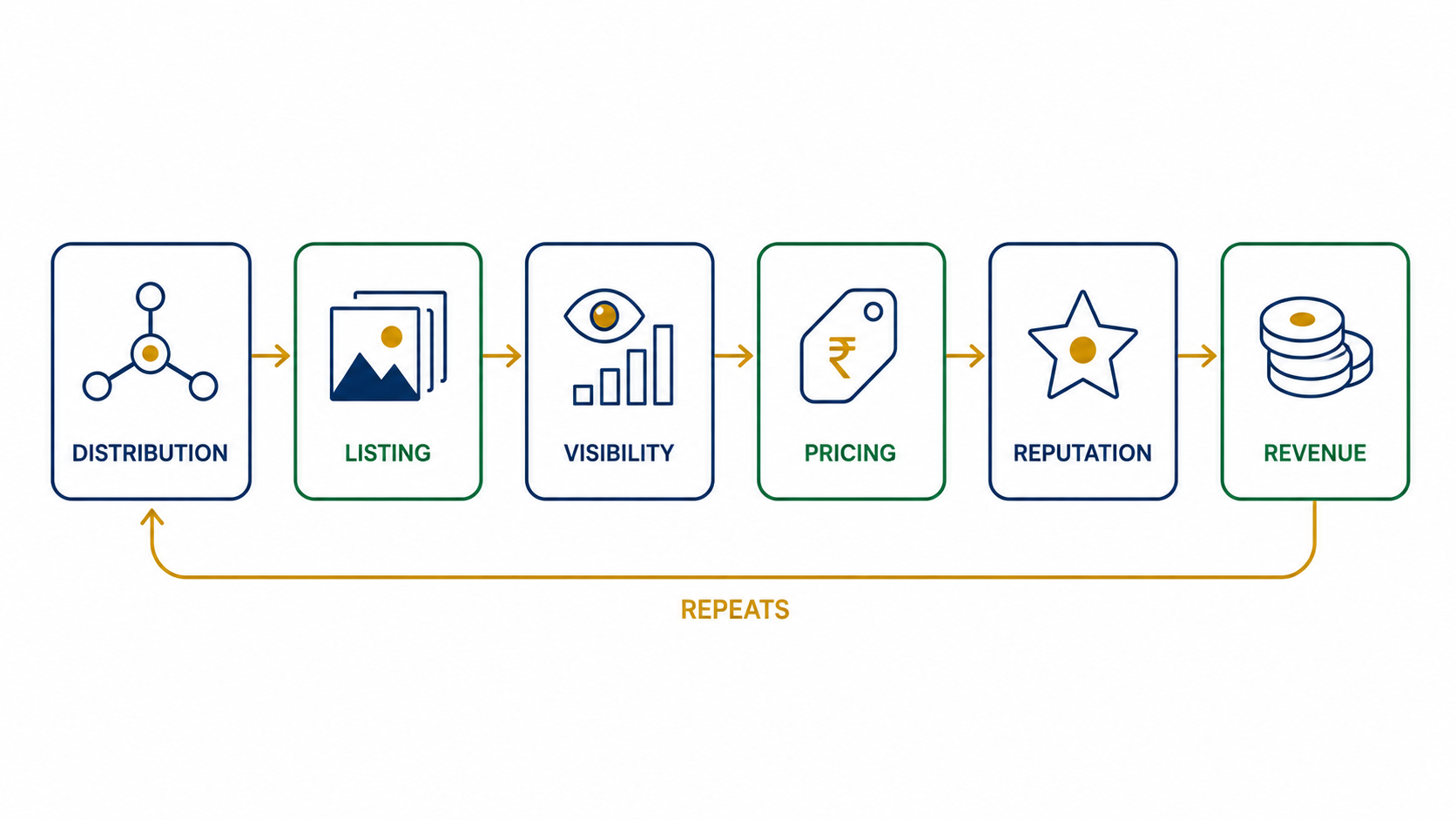
Know your guest before you choose your platform. Get your listing right before you chase visibility. Understand your comp set before you set a rate. Forecast demand before you price. Manage your reputation like it feeds your ranking, because it does. And once rooms are running well, look at what the rest of the property is earning.
Each step feeds the next. Skip one and the others underperform. That is the system.
Most revenue management advice treats these as separate decisions. Fix pricing. Improve the listing. Get more reviews. Each one in isolation. Remove any one of them and the others underperform. Fix only one and wonder why results disappoint. MMR manages all six together. That is the framework.
The system makes sense on paper. What's harder is that most of the decisions that undermine it don't look wrong when you're making them. They look like reasonable calls. The evidence shows up weeks later.
Common Hotel Revenue Management Mistakes
Most of these mistakes are not complicated. They persist not because hotel teams don't understand revenue management but because fixing them means changing something that has been running on autopilot for months, sometimes years.
Treating Occupancy as the Primary KPI
Full hotel, thin margins. It happens more than it should.
A property at 88 percent occupancy with a Rs. 2,100 ADR is not automatically outperforming one at 71 percent with a Rs. 3,400 ADR. Depending on commission structure and operating costs, the higher occupancy property can actually be less profitable per available room. Run the numbers properly and the comfortable-looking scorecard starts to look different.
The instinct to fill rooms first and sort out rate later is understandable. Empty rooms feel like failure in a way that full rooms at the wrong rate simply don't. The maths does not share that instinct.
Setting Flat Rates Across All Dates
One rate for a Tuesday in March. Same rate for the Tuesday before a major wedding weekend in the same city. That is not a pricing strategy. That is a default with a number on it.
Every property needs a floor rate. A minimum below which it never goes, based on actual cost per occupied room plus a margin. Most hotels either have no defined floor or have one set three years ago that nobody adjusted for cost inflation. Which means they occasionally sell rooms below profitability without realising it.
Discounting Too Far in Advance
Dropping rates more than three weeks before arrival to secure early occupancy trains guests to book in that window at lower prices. Standard rate bookers learn that waiting gets them a better deal. The discount window expands. Over time the discounted rate becomes the effective market rate and the standard rate exists mainly on paper.
Getting back from this takes months. Usually costs occupancy before it recovers.
Ignoring the Booking Window
When bookings arrive matters almost as much as how many arrive. A property filling up 45 days out has completely different options than one filling up 5 days out, even if both end at similar occupancy by arrival.
Pickup curve analysis, watching how bookings accumulate toward a specific date, is one of the more useful habits in revenue management. Weirdly it gets skipped most often when demand is volatile and the pickup data would actually be most informative. That is exactly backwards.
Copying Competitors Without Context
Knowing what the comp set is charging is useful. Matching it without understanding why is not strategy.
They might be running a different cost structure. Targeting a different guest segment. Or simply wrong about their own pricing. A hotel in Jaipur that copies the rate of a property two streets over without knowing that property is running a corporate contract rate that Tuesday is making a decision based on incomplete information.
Know what they are charging. Understand why. Then decide.
Entering OTA promotional programs under pressure during a slow period and then struggling to exit cleanly. Some programs tie ranking benefits to continued participation in ways that are not obvious until you try to reduce participation. Read the terms before opting in. Exiting mid-program can drop your ranking faster than the slow period that pushed you in.
These mistakes show up across every property type. But which ones hit hardest depends entirely on what kind of hotel you are running.
Hotel Revenue Management by Hotel Type
The rules of revenue management are the same for every hotel. Fixed rooms, perishable nights, variable demand.
But how you apply those rules depends on what kind of hotel you are running.
Know Your Positioning First
Before any of this applies, know what you are actually selling.
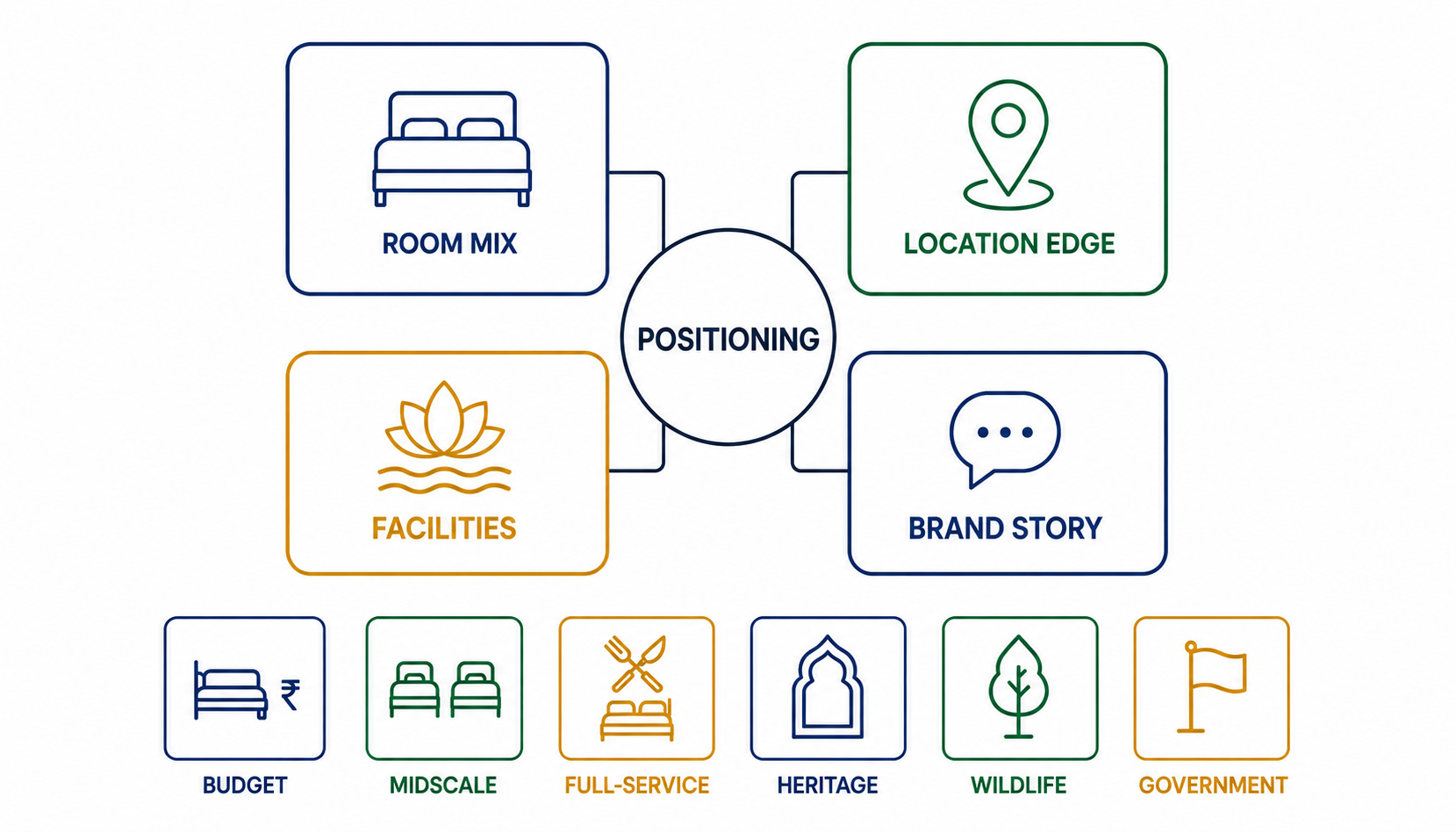
Two properties can be the same size, same city, same star rating, and still need completely different revenue strategies because of what makes each one distinct. A quick audit before anything else: what is the room mix, what does the location actually offer that competitors don't, what facilities exist that guests pay for versus ones that just sit there unused, and what does the brand or property story actually signal to someone scrolling through search results.
This matters because pricing power comes from positioning, not from category labels. A "budget hotel" with a genuinely unique location, near a temple, a station, a market that draws repeat footfall, has more pricing room than the budget label suggests. A "full-service hotel" with a tired conference room nobody books has less pricing power than the category implies.
Most hotels skip this step and jump straight to copying whatever the property next door is doing. Worth doing the audit first. Then the hotel type guidance below actually fits the property instead of fitting the category it happens to sit in.
Budget Hotel Revenue Management
Guests booking budget hotels decide fast. Usually within a week of travel, sometimes the same day.
So the focus here is simple. Do not drop rates too low. Keep your listing complete. Respond to reviews. A budget hotel with good photos and a 4.0 review score on MakeMyTrip will always outperform a cheaper property with four photos and no reviews. Every time.
Midscale Hotel Revenue Management
Guests here are not just looking at price. They are looking at value. Is this hotel worth what it is charging compared to the one next to it?
This is where structured revenue management produces the biggest improvements. Dynamic pricing works here because guests have enough flexibility in budget to respond to value signals, not just the lowest number on screen.
Full-Service Hotel Revenue Management
Rooms are only part of what these hotels earn. Restaurant, spa, conference rooms, events. Revenue management here is not just about room rates. It is about making sure every department is earning what it should.
The metric that matters most here is not RevPAR. It is GOPPAR and TRevPAR. What is the hotel actually earning across everything, after costs.
Heritage and Boutique Hotel Revenue Management
These properties are not competing on price. A heritage haveli in Jodhpur is selling an experience. The guest is not looking for the cheapest option. They are looking for something specific.
Which means two things. First, do not discount heavily. Discounting a heritage property attracts the wrong guest. Second, listing quality and reputation matter more here than anywhere else. Photos need to show the character of the place. Reviews need to consistently reflect the experience.
Wildlife Resort Revenue Management
These properties earn most of their annual revenue in a short window. Peak season can be 60 to 70 percent of the whole year compressed into 90 to 120 days.
Underpricing peak dates here is expensive. Not just for that night. For the whole year.
Wildlife travellers book 30 to 90 days in advance. That is enough time to raise rates as peak dates fill. Hold the rate. Do not offer last minute deals that give away the season's margin in the final two weeks.
Government Hotel Revenue Management
Most people assume government properties cannot be managed commercially. That assumption is wrong.
MMR worked with the Madhya Pradesh Tourism portfolio. Same properties, same markets. Applied systematic OTA visibility and direct channel development. Revenue went from Rs. 1.67 crore to Rs. 2.72 crore. The constraint at government properties is usually process, not potential.
The principles work everywhere. What changes is which numbers to watch most closely depending on what kind of property you are running.
Hotel Revenue Management Metrics: What to Track
Hotel revenue management runs on numbers. Not all of them matter equally.
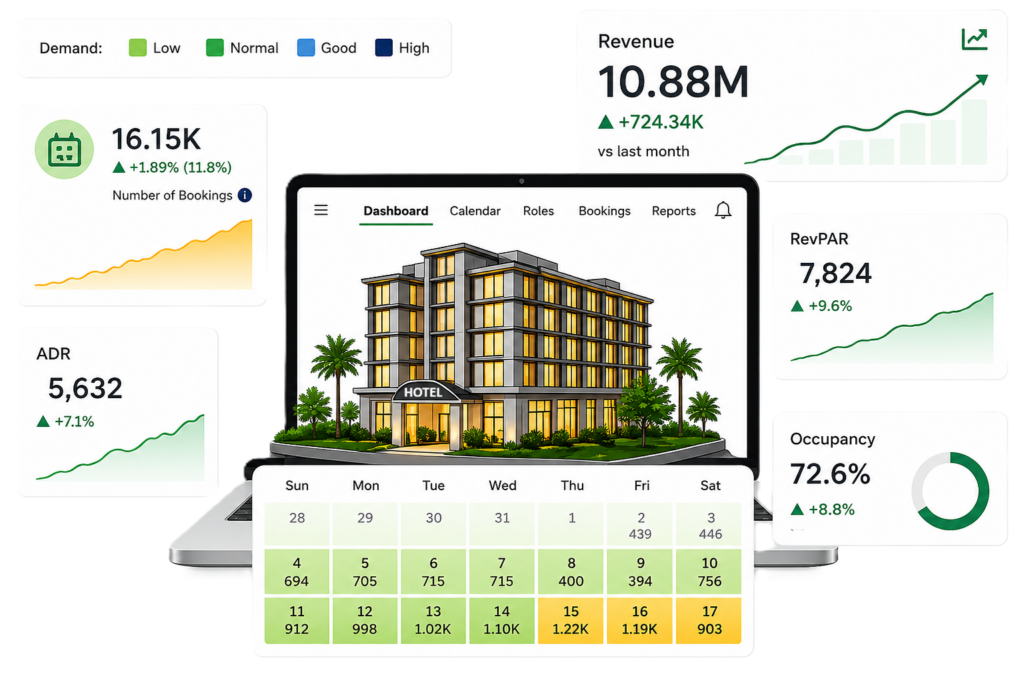
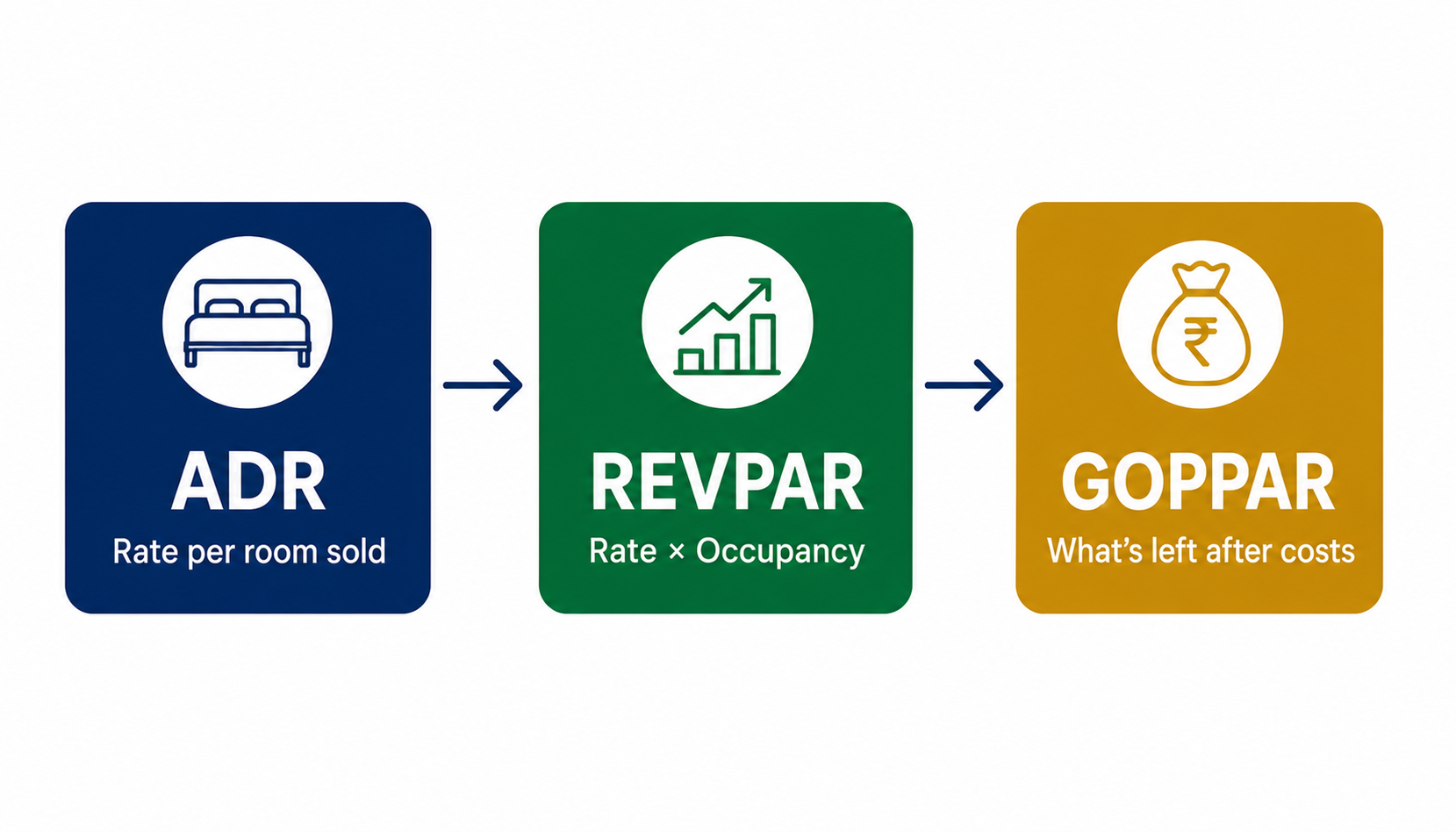
ADR, RevPAR, GOPPAR. These three tell you whether your hotel is actually performing or just staying busy. Everything else either feeds into one of these or helps explain why one of them moved when you weren't expecting it.
The mistake most hotels make is tracking metrics as a reporting habit rather than a decision tool. Monthly P&L meeting, everyone looks at the numbers, nobody changes anything. That is not revenue management. That is a ritual.
| Metric | Formula | What it measures | Tracking frequency |
|---|---|---|---|
| Occupancy Rate | Rooms Sold / Available Rooms x 100 | Inventory fill rate | Daily |
| ADR | Room Revenue / Rooms Sold | Average rate per occupied room | Daily |
| RevPAR | ADR x Occupancy Rate | Revenue efficiency across all available rooms | Daily |
| NRevPAR | Net Room Revenue after commission / Available Rooms | Revenue efficiency after OTA distribution cost | Weekly |
| TRevPAR | Total Revenue / Total Available Rooms | Full-property revenue including F&B, spa, events | Weekly |
| GOPPAR | Gross Operating Profit / Available Rooms | What actually reaches the P&L after costs | Monthly |
| ALOS | Total Room Nights / Total Bookings | Average length of stay | Weekly |
| CPOR | Total Operating Costs / Occupied Rooms | Cost per sold room | Monthly |
ADR is the one that flatters you most. It measures average rate per occupied room, which means it completely ignores the rooms you didn't sell. A property at 44 percent occupancy with a strong ADR looks fine on that number alone and is in real commercial trouble. I've seen ownership presentations built almost entirely on ADR growth that were quietly masking a RevPAR slide nobody caught, usually because the occupancy data was sitting in a different tab nobody opened at the same meeting.
RevPAR fixes that blind spot. It combines occupancy and rate into one number, so you can't hide weakness in either. If ADR goes up but occupancy drops, RevPAR tells you immediately. Its limitation is scope: it only measures room revenue. For budget properties that's close to the whole picture. For resorts and full-service hotels with real F&B and conference revenue, RevPAR alone is missing a significant part of the story.
GOPPAR is where the distribution cost finally shows up. Shifting 20 percentage points of OTA volume to direct bookings at a property doing Rs. 1 crore in room revenue drops annual distribution cost from roughly Rs. 14 lakh to Rs. 8 lakh. That Rs. 6 lakh difference doesn't appear anywhere in RevPAR. It only shows in GOPPAR. Which is why hotels that track RevPAR but not GOPPAR often feel like they're doing well while the owner wonders where the money went.
NRevPAR sits between RevPAR and GOPPAR. Net revenue per available room after OTA commissions are deducted. Useful for understanding exactly what distribution is costing before you get to operating expenses. Most GMs know their commission percentage. The annualised rupee figure tends to stay invisible until someone calculates it properly, usually during an audit when something else already looks wrong.
RevPAR for daily rooms tracking. NRevPAR to understand what distribution is actually costing. GOPPAR for ownership reporting and channel mix decisions. TRevPAR for properties where F&B, spa, or conference revenue is material. Tracking only RevPAR is like checking the speedometer without looking at the fuel gauge.
Once you know which numbers to track, the next question is what tools help you manage them without it becoming a full time manual job.
AI and Technology in Hotel Revenue Management
The technology conversation in hospitality moves in a strange pattern. Whatever is genuinely useful tends to arrive about three years before most properties are ready to use it. Whatever gets marketed heavily tends to arrive about two years before the underlying data infrastructure can support it. Both things are true right now in 2026.
AI-powered revenue management tools work. For properties with clean, consistent data feeding them. For properties without that foundation, the recommendations look sophisticated and produce expensive guesses.
Hotel Revenue Management Software
Most hotels buy in the wrong order. The RMS gets purchased first because it sounds like the most advanced solution, and six months later the team discovers the recommendations make no sense because the PMS data feeding it has been inconsistent for years. Nobody flagged it because nobody was looking.
The right order is foundation first. PMS accurate and maintained. Channel manager syncing inventory in real time across every OTA. Booking engine that loads fast on a mid-range Android device, not just on a desktop browser with a strong connection. Rate intelligence tool pulling competitor rates daily. Then, once that stack is stable and the data is clean, an RMS on top.
A proper RMS ingests booking data, competitor rates, historical occupancy, local event calendars, and pickup curves, then generates rate recommendations across the booking window. The gap between those recommendations and a flat rate set once a week is measurable, typically 8 to 15 percent RevPAR improvement in year one. But only when the data underneath it is clean. Feed it garbage and it produces confident-sounding garbage.
AI demand forecasting has improved meaningfully. Models trained on regional booking data, local event patterns, and macro signals can anticipate demand shifts more accurately than manual analysis at most property sizes. Dynamic pricing automation is the other area where it earns its keep. Rate rules that would take a revenue manager three hours to configure and monitor can run continuously with guardrails you set. The guardrails matter. Fully automated pricing without a human-defined floor and ceiling produces occasional errors that are more embarrassing than anything a manual process would generate.
A channel manager with real-time two-way sync. Not an RMS. Not AI-powered forecasting. Properties are still managing rates manually across OTA extranets one by one, which means rate changes take longer, errors happen more often, and the person doing it has less time for everything else. That problem is solvable with a tool that has been around for a decade and costs less than most hotels assume.
That is the framework, the mistakes to avoid, and the tools to run it. Here is what it actually produces when applied to real properties across India.
The Future of Hotel Revenue Management in India
Predicting where hospitality technology goes is a reliable way to be approximately wrong in interesting ways. A few directions feel reasonably certain based on what is already moving.
Personalised pricing at the individual guest level, meaning rates that vary not just by date and channel but by the specific booking profile of the person looking, is moving from airline practice toward hotel reality. The data infrastructure required is significant and most properties are not close to having it. But the OTA platforms are, and they are already running versions of this on their end in ways that hotel operators cannot see clearly.
Direct booking capability is becoming less optional. OTA commission rates have been rising consistently. Properties without a functional direct channel are increasingly price-takers in a market where intermediaries are getting more expensive and more powerful at the same time. Building a direct booking capability now, while it is still a differentiator, is easier than building it later when it has become a necessity.
Platform consolidation is accelerating. The fragmented tech stack where data lives in four systems that require manual reconciliation every week is a real operational cost. Integrated platforms reduce that friction. They also create single-vendor dependency that carries its own risks. Worth thinking through before committing to a platform that is difficult to exit.
AI will get better at demand forecasting, probably meaningfully better over the next two to three years. Whether that improvement translates into actual RevPAR gains for individual properties depends more on data quality and implementation discipline than on the sophistication of the algorithm. The best forecasting model available cannot compensate for a PMS that has been miscategorising room types for eighteen months.
Get the data clean. PMS records accurate, channel manager synced, booking source attribution consistent. Not a technology story. Not exciting. But every useful revenue management decision, human or AI-assisted, runs on that foundation. Properties that skip data hygiene and buy sophisticated tools tend to discover the problem about six months into implementation when the recommendations stop making sense.
Real Results: MMR Hotels
These are real commercial outcomes from properties where MMR applied the framework. Numbers from actual P&Ls and OTA dashboards. The cases where something went wrong are more instructive than the ones that went cleanly, so both are included.
These results came from managing what exists today. The question is what changes over the next few years and whether your hotel is positioned for it.
All Guides in This Pillar
Each guide covers a specific area in depth. Start with the ones most relevant to your current situation.