Low season at a small property usually produces one of two responses: panic discounting or passive waiting. Neither works particularly well. Panic discounting trains guests to expect lower rates, making it harder to recover ADR when demand returns. Passive waiting means empty rooms and fixed costs with nothing coming in. There is a third approach, and it is less complicated than most hotel owners expect.
Low Season Is a Positioning Problem, Not Just a Demand Problem
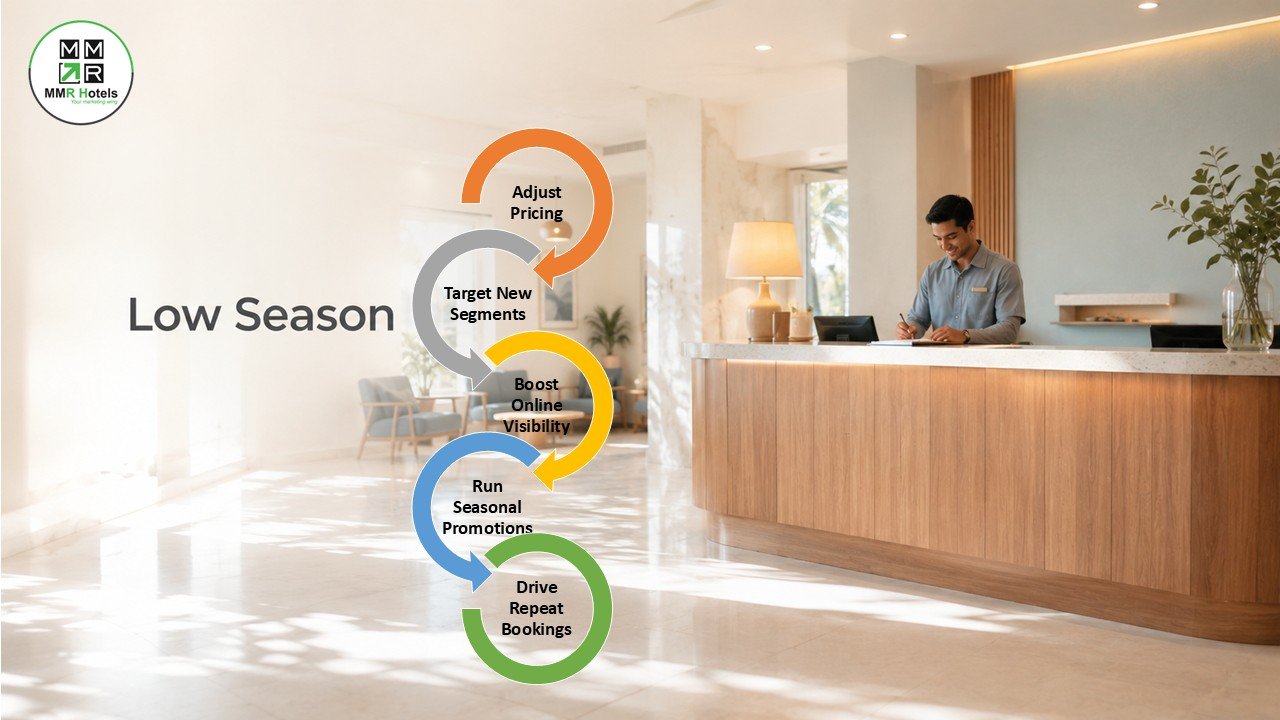
The assumption most properties make is that low season has less demand, so the only answer is lower prices. That's partially true. Demand is softer. But the guests who are travelling during low season are often a different segment entirely, with different priorities and different willingness to pay, and most hotels do nothing to speak to them specifically.
A hill station property in monsoon season has lower leisure demand but potentially higher demand from guests specifically seeking the monsoon experience: photographers, nature travellers, guests who dislike crowds. A beach resort in the off-peak shoulder months has lower family demand but potentially higher demand from couples and solo travellers who prefer a quieter property. The positioning that worked in peak season won't reach these guests. Different segments, different message.
Before cutting rates, identify who does travel to your destination during the low period. Corporate groups doing offsites. Wedding guests when venues are cheaper. Domestic travellers on extended weekends. Long-stay remote workers. Each segment has different triggers and different booking channels. Rate cuts reach everyone equally. Targeted positioning reaches the right people specifically.
Build Packages That Create Reasons to Travel
Standard room rates in low season produce standard-or-below conversion because there is no urgency and no reason specific to the time period. Packages that are specific to the season give guests a reason to come now rather than waiting for peak season.
A monsoon package at a hill station that includes a guided waterfall trek, a bonfire evening, and a local breakfast is not just a discounted room with extras. It is a curated experience that makes the low season feel like the right time to visit rather than a consolation period. The package price can often be higher than a discounted room-only rate because the value is visible and specific.
Packages that work in low season: wellness retreats (yoga, Ayurveda, meditation), creative experiences (cooking classes, local craft workshops), nature and photography experiences, remote work packages (stable WiFi, workspace, long-stay rates), and destination-specific seasonal experiences (harvest season, festival coinciding with low hotel season).
Target Segments That Move in Your Off-Season
| Segment | Why They Travel Off-Peak | How to Reach Them |
|---|---|---|
| Corporate retreat groups | Venues and rates are more negotiable. Less crowded. Easier to book group blocks. | Direct outreach to HR and admin teams. Corporate rate offers. Conference package pricing. |
| Remote workers | No school term dependency. Prefer quieter properties. Value stable WiFi and workspace. | Long-stay rate plans. Remote work package messaging on OTAs and direct channel. |
| Couples without children | Not bound by school holidays. Prefer fewer families and children around. | Romantic package offers. Quiet season messaging. Couple-specific amenities highlighted. |
| Domestic weekend travellers | Driving distance from metro cities. Short getaway with no air travel required. | Friday to Sunday package. Last-minute availability visibility on OTAs. Google Hotel Ads on brand name. |
Adjust Distribution, Not Just Rates
In low season, channel mix strategy changes. The guests who are travelling may be more reachable through direct outreach to past guests than through OTA search volume. If the past guest database has 300 to 500 contactable emails from prior direct bookings, a seasonal email with a specific low-season offer converts at a much lower cost than an OTA promotion that applies to everyone.
OTA promotions in low season are not wrong, but they should be targeted at the dates that genuinely need filling, not applied uniformly across the entire period. A Monday to Thursday rate discount with no weekend discount is more financially intelligent than a blanket seasonal reduction. Weekends in low season often have some residual leisure demand. Weekdays rarely do unless corporate or group business is being targeted specifically.
Protect Rate Even When Occupancy Is Soft
The most damaging low-season decision most small hotels make is cutting rates to the point where RevPAR actually declines faster than if they had held rates and accepted lower occupancy. An 85% occupancy at INR 2,800 ADR produces lower RevPAR than 55% occupancy at INR 4,200 ADR in many cost structures, particularly when the variable cost of each additional occupied room is accounted for.
There is a floor below which rate cuts produce more occupied rooms but less actual revenue and profit. Most properties cut past that floor without realising it. Track RevPAR, not just occupancy, during low season. If RevPAR is improving with rate cuts, continue. If it is declining despite rising occupancy, the cuts have gone too far.
Build one season-specific package and promote it directly to past guests via email or WhatsApp. Identify one corporate or group segment and make two direct outreach calls. Open long-stay rates (5 nights or more) at a 20% discount to attract extended stays that fill multiple nights without further discounting.