

How Guests Search for Hotels
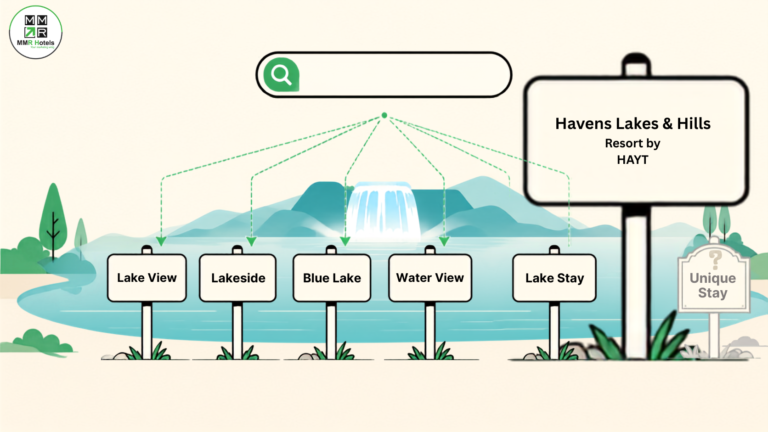
Understanding how guests search is the foundation of hotel SEO strategy. Different search queries represent different levels of booking intent and require different types of content to rank and convert.
| Search Type | Example Queries | Booking Intent | What the Hotel Needs to Rank |
|---|---|---|---|
| Branded Search | "The Blue Banyan Rishikesh", "Koti Heritage Hotel Jodhpur" | Very high: guest is looking specifically for this property | Hotel website in position 1 organically. Google Business Profile complete. Google Hotel Ads active. OTAs should not appear above the hotel's own website for its own name. |
| Location-Based | "Hotels in Coorg", "hotels near Charminar Hyderabad", "budget hotels Manali" | High: guest is searching for accommodation in a specific destination | Destination landing pages on the hotel website optimised for these queries. Local SEO signals from Google Business Profile. Difficult to compete with OTAs at this level without strong domain authority. |
| Amenity-Based | "hotel with pool in Goa", "pet-friendly hotel Ooty", "hotels with sea view Kovalam" | High: guest has a specific requirement and will book the property that best matches it | Room and amenity pages that explicitly mention the specific amenity. Structured data marking up the hotel's amenities. Google Business Profile attributes. |
| Purpose-Based | "wedding venue near Jaipur", "corporate retreat hotel Lonavala", "romantic getaway Shimla" | High with long booking lead time: guest is planning a specific occasion | Dedicated landing pages for each purpose (weddings, corporate, romance, family). Content that addresses the specific occasion requirements in detail. |
| Informational | "best time to visit Coorg", "things to do in Udaipur", "Goa beach guide" | Low to medium: guest is in research phase, not yet booking | Travel guide content on the hotel website or blog. Guest who reads the hotel's destination guide is more likely to book with the property that provided helpful information. |
When a guest searches the hotel's own name on Google, Booking.com and MakeMyTrip often appear above the hotel's website in organic results, having invested in SEO for the hotel's name. They also bid on the hotel's brand keyword in Google Ads. A guest who intended to book direct sees OTA listings first, clicks one, and completes a booking that generates a commission the hotel shouldn't have paid. The SEO investment that prevents this leakage is not about ranking for "hotels in Delhi." It is about ensuring the hotel's own website appears before OTA listings when a guest specifically searches the hotel's name.
Branded Search Optimisation
Branded search is the highest-priority SEO task for most hotels because it addresses the most commercially damaging leakage: guests who intended to book direct but were intercepted by OTA listings for the hotel's own name. Fixing this requires both technical SEO on the hotel website and Google Business Profile optimisation.
Why OTAs Rank for Hotel Brand Names
OTAs invest heavily in ranking for individual hotel names. They have high domain authority (Booking.com's domain authority is among the highest on the internet), they have structured data markup for hotel listings, and they have pages specifically about each hotel that are well-optimised and extensively linked. A hotel with a basic website and few inbound links will lose to Booking.com and MakeMyTrip in organic rankings for its own name in many cases.
The practical defence: make the hotel website as technically strong as possible for brand search, maintain a complete and active Google Business Profile with a direct booking link, and run Google Hotel Ads on brand keywords to ensure the hotel's direct rate appears prominently in the rate comparison panel regardless of organic ranking position.
Technical Requirements for Branded Search Visibility
The hotel website should have: the property name in the H1 tag and the title tag of the homepage; a clear, fast-loading homepage that gives Google strong signals about what the property is and where it's located; the property's full address in the footer of every page; a LocalBusiness or LodgingBusiness schema markup with the property name, address, phone, and URL; and an active, verified Google Business Profile with a website link pointing to the hotel's direct booking page rather than the homepage alone.
Protecting Brand Traffic
Google Hotel Ads on brand keywords is the fastest intervention for brand search protection. Even if Booking.com ranks above the hotel website organically, a guest who sees the hotel's direct rate in the Google Hotel Ads comparison panel before any other result has an immediate direct booking option. The cost per click on the hotel's own brand keyword is low (typically INR 8 to 25) because few advertisers compete for it. The conversion rate is high because these are already brand-aware guests.
Local SEO for Hotels
Local SEO is the practice of optimising the hotel's online presence to appear in location-based searches. "Hotels in Mysore," "hotels near Mysore Palace," and "best heritage hotels Mysore" are all local searches. The primary tool for local SEO is the Google Business Profile, supported by consistent NAP (Name, Address, Phone) data across the web, local citations, and review volume.
Google Business Profile as a Local SEO Foundation
The GBP is the most direct connection between the hotel and local search results. A complete, active, well-reviewed GBP ranks in the Google Maps local pack (the map results that appear at the top of location-based searches), receives traffic from guests searching the area, and displays the hotel's review score, photos, and direct booking link to any guest who sees it. An incomplete or unclaimed GBP forfeits this visibility entirely.
What "complete" means for a hotel GBP: claimed and verified ownership; all categories filled in (primary category: Hotel; secondary categories: Boutique Hotel, Heritage Hotel, Resort, or whatever is accurate); minimum 25 photos covering all major property areas; responses to all reviews; current hours for any restaurant or spa; direct booking URL in the website field; and amenity attributes updated to reflect the property's current offerings.
NAP Consistency
Google's local ranking algorithm uses the consistency of the hotel's Name, Address, and Phone number across all online directories as a trust signal. A property listed as "The Blue Banyan Rishikesh" on its website but "Blue Banyan Hotel" on JustDial and "Blue Banyan, Rishikesh" on MakeMyTrip has three different NAP variations. These inconsistencies reduce the local ranking confidence the algorithm can assign to the property. Audit the hotel's name, address, and phone across the 10 most common directories and OTAs. Standardise them to one consistent format.
| Local SEO Signal | How to Optimise It | Impact Level |
|---|---|---|
| Google Business Profile completeness | Complete all sections. Update photos quarterly. Respond to all reviews. Post GBP updates at least monthly. | High: the primary local SEO signal for hotel searches |
| Review volume and recency | Systematic review request process at checkout and post-stay. Minimum 5 new reviews per month for small properties. | High: confirmed local ranking factor |
| NAP consistency | Audit and standardise name, address, and phone across all directories, OTAs, and social media profiles. | Medium: inconsistency suppresses local ranking confidence |
| Local landing pages | Hotel website pages that mention specific nearby landmarks, attractions, and the destination name in content and meta tags. | Medium: helps the hotel website rank for destination-specific queries |
| Local citations | Listings in relevant Indian directories: JustDial, Sulekha, Indiamart (for conference venues), tourism board listings, local business directories. | Low to medium: builds the citation profile that supports local ranking |
Hotel Website Architecture and On-Page SEO
The hotel website's structure determines which pages can rank for which queries. A website that has only a homepage, an about page, a rooms page, and a contact page is competing for every query with the same domain authority. A website structured with individual pages for each room type, separate amenity pages, destination guide content, and purpose-specific landing pages distributes ranking potential across dozens of pages each targeting specific queries.
Essential Pages for Hotel SEO
| Page Type | Target Query | Required Content | SEO Priority |
|---|---|---|---|
| Homepage | Brand searches: "[Hotel Name]" | Property name in H1, direct booking CTA above fold, address in footer, LodgingBusiness schema, Google Hotel Ads connection | Critical |
| Individual room pages | "[room type] hotel [destination]", "hotels with [feature] in [destination]" | Room name in H1, detailed description, photos, occupancy, amenities, price range. Each room type as a separate page, not a single "Rooms" page with all types listed. | High |
| Amenity pages | "hotel with pool [destination]", "hotel with restaurant [destination]" | Amenity name in H1, photos, operating hours, booking information, connection to rooms where relevant | High for properties with notable amenities |
| Destination guide | "things to do in [destination]", "best time to visit [destination]", "[destination] travel guide" | Genuinely useful local information: attractions, transport, weather, local food, timing. Should be more useful than generic travel site content. | Medium: builds topical authority and attracts informational-stage traffic |
| Purpose pages | "wedding venue near [destination]", "corporate retreat [destination]", "family hotel [destination]" | Purpose-specific content addressing the guest's specific needs for that occasion type | High for properties with significant revenue from specific purposes |
| Nearby attractions pages | "hotels near [landmark]", "[landmark] accommodation" | Hotel distance from the landmark, transport options, why the hotel is a good base for visiting the attraction | Medium to high depending on landmark traffic volume |
Technical SEO Basics
Core Web Vitals, Google's page experience signals, directly affect ranking for hotel websites. The three metrics that matter: Largest Contentful Paint (LCP, ideally under 2.5 seconds), Cumulative Layout Shift (CLS, ideally under 0.1), and Interaction to Next Paint (INP, ideally under 200 milliseconds). For most hotel websites, LCP is the most commonly failing metric because of large uncompressed hero images. Compressing the hero image, switching to modern image formats (WebP), and enabling browser caching resolves most LCP issues without a website rebuild.
Mobile-first indexing means Google primarily uses the mobile version of the hotel website for ranking. A website that looks fine on desktop but has a poor mobile experience will rank worse than its content quality would otherwise suggest. Test the hotel website on an actual mobile device, not a desktop browser in mobile emulation mode. Emulation doesn't replicate actual mobile network conditions or touch navigation behaviour accurately.
Structured Data for Hotels
Structured data (schema markup) tells Google explicitly what the hotel website is about. Without it, Google infers the property type, location, and offerings from the page content. With it, Google has structured information that enables rich search results and improves the confidence of the hotel's appearance in hotel-specific search features.
| Schema Type | What It Marks Up | Where to Implement |
|---|---|---|
| LodgingBusiness | Core hotel information: name, address, phone, URL, star rating, amenities, check-in/check-out times, price range | Homepage. This is the most important schema for hotels and should be implemented first. |
| HotelRoom | Room type information: name, description, occupancy, bed type, amenities, price | Individual room type pages |
| Review | Guest reviews: reviewer name, rating, review text, date | Any page displaying guest reviews. Enables star rating display in search results. |
| FAQPage | FAQ content that may appear as expandable results in Google search | FAQ pages or sections on room pages, destination guides, and the homepage |
| LocalBusiness | Business location and contact information for local search | Homepage (in addition to LodgingBusiness). Reinforces local search signals. |
SEO and Direct Booking Optimisation
SEO traffic that doesn't convert to direct bookings has limited commercial value. The connection between SEO performance and direct booking revenue requires that the website receiving the organic traffic is optimised for conversion as well as for ranking. A hotel website that ranks well for "boutique hotels Jaipur" but has no visible direct booking incentive, a slow-loading booking engine, and no payment method Indian guests prefer is generating organic traffic for OTAs to capture.
| SEO to Direct Booking Connection | What Breaks the Connection | Fix |
|---|---|---|
| Guest finds hotel website through organic search | Website takes 8 seconds to load on mobile. Guest abandons before seeing any content. | Compress images. Move to faster hosting. Fix Core Web Vitals LCP score. |
| Guest reads room content and decides to book | No visible direct booking incentive on the page. Guest opens Booking.com to compare and books there. | Add "Book direct: complimentary breakfast included" prominently on every room page near the Book Now CTA. |
| Guest clicks Book Now and enters booking engine | Booking engine conversion problems prevent completion. | See Booking Engine Guide. The SEO investment is wasted if the booking engine fails to convert. |
Measuring SEO Performance
| Metric | Tool | Target Direction | Review Frequency |
|---|---|---|---|
| Organic Traffic | Google Analytics 4 | Growing month-on-month and year-on-year | Monthly |
| Branded Search Impressions | Google Search Console | Stable or growing. Flat or declining branded impressions means awareness is not building through owned channels. | Monthly |
| Organic Conversion Rate | Google Analytics 4 (organic sessions → booking engine sessions → confirmed bookings) | Above 1.5% from organic sessions to confirmed bookings | Monthly |
| Position for Target Keywords | Google Search Console, keyword tracking tool | Improving position for destination and amenity keywords over 3 to 6 month windows | Monthly |
| Core Web Vitals Score | Google PageSpeed Insights, Google Search Console | All three metrics in green (passing) on mobile | Quarterly |
| GBP Impressions and Clicks | Google Business Profile Insights | Growing impressions and click-to-website rate | Monthly |
Frequently Asked Questions
Want this set up for your property?
We'll review this against your hotel's current setup, free of charge.