

What Is Hotel Dynamic Pricing?
Room rates that move. That's the short version.
The longer version: instead of printing a rate card in April and living with it until October, you adjust prices as demand shifts. A hotel near the airport in Hyderabad might sell the same room for 3,200 on a dead Wednesday and 7,800 during a convention week. Same bed, same breakfast. Different market.
People hear "dynamic pricing" and assume software. It doesn't have to be. Plenty of smaller properties do this with a spreadsheet and a habit of checking competitor rates before the front desk gets busy. Software is faster and doesn't forget, which matters, but the strategy came first and the tools came later.
And no, it is not discounting. Discounting only goes down. This goes both ways, and honestly the "up" direction is where most of the missed revenue sits. Hotels are weirdly comfortable dropping rates and weirdly nervous raising them, even on dates where they'll sell out regardless.
Airlines figured this out in the 80s. Hotels took longer, partly because rate transparency wasn't forced on them until OTAs let every guest compare five properties in thirty seconds.
Works for a 12-room heritage property in Udaipur. Works for a Marriott.
A pricing approach where room rates change continuously based on demand, competition, booking patterns, and market conditions instead of staying fixed by season.
How It Works
Every morning, somewhere, a revenue manager opens three tabs before touching their coffee. Booking pace. Comp set rates. The PMS.
Quick translations for anyone newer to this: booking pace is how fast reservations are coming in for a future date, pickup is what landed in the last day or two, and the comp set is the handful of hotels you genuinely compete with for the same guest.
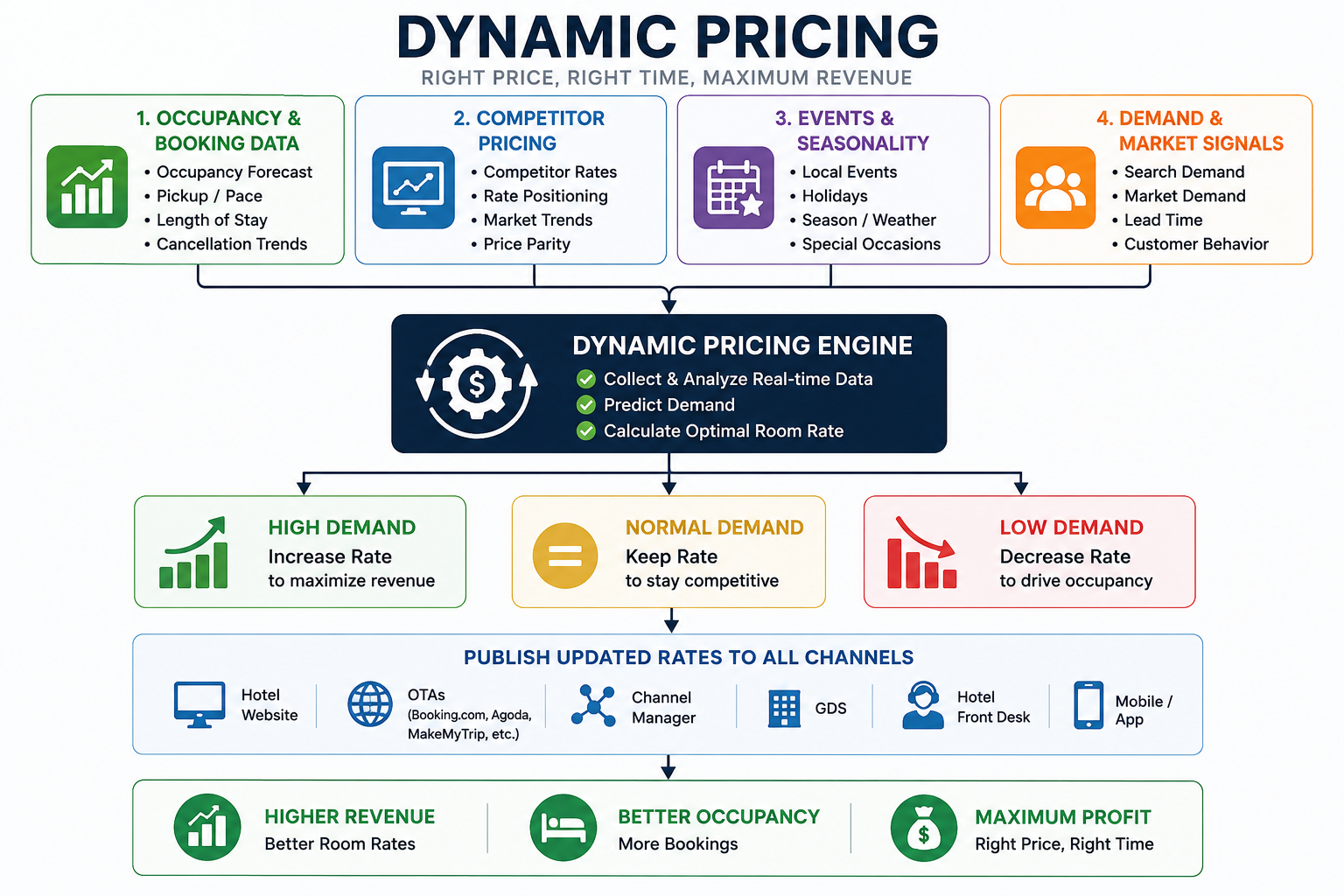
That routine is the whole engine, honestly. How fast are rooms filling for each future date versus last year? What came in overnight? What are your five real competitors showing right now? Anything happening locally, a concert, exam season, a long weekend nobody noticed until Tuesday?
Then rules take over. Cross 70% occupancy for a date, push the rate a tier. Cross 85%, push again. Sitting under 40% with two weeks left... that's when the arguments start. Drop and protect occupancy, or hold and protect ADR. Reasonable people disagree, usually in a WhatsApp group at 11pm.
Booking window matters more than people expect. A guest booking 60 days out is shopping around. One booking from the taxi is not. Price them identically and you lose on both ends.
Automated systems run this loop constantly, repricing several times a day without asking anyone. Manual setups do it once each morning, which is fine until a demand spike shows up on Monday and the human catches it Thursday.
One thing software demos skip: the override button gets used a lot. Algorithms don't know the city flooded yesterday.
The gap between when a guest books and when they arrive. Short windows usually mean urgency and less price sensitivity; long windows mean comparison shopping.
Static vs Dynamic Pricing
Static pricing is a rate card. Season rates, maybe a weekend supplement, done. It was fine when guests booked by phone and nobody could compare.
The problem shows up at both ends of the demand curve. During a sold-out week, a static hotel sells its last ten rooms at the same price as its first ten, leaving thousands on the table per room. During a dead week, its published rate sits above everyone who adjusted, so it loses the few bookings that were available too.
Some segments still run partly static, and not stupidly. Long-term corporate contracts, government rates, certain wedding blocks. Fixed rates buy predictability, and some clients pay for that predictability. So the real answer at most properties is a mix: contracted business at negotiated rates, everything else floating.
But for transient demand through OTAs and the website, static pricing in 2026 is basically donating margin to whoever bothered to look at the calendar.
The choice isn't static versus dynamic across the whole operation. It's knowing which segments justify fixed rates and letting everything else respond to the market.
Benefits
Revenue first, obviously. Properties moving from fixed to dynamic rates typically see RevPAR (revenue per available room, so total room revenue divided by all rooms whether they sold or not) climb somewhere between 5 and 20 percent in the first year. The range is wide because starting points vary; a hotel that was badly underpriced on weekends gains fast, one that was roughly right gains less.
There's a quieter benefit that gets less airtime: you stop making pricing decisions in a panic. When rates already respond to pace, you're not slashing 30% three days out because someone just noticed the date is empty. Those emergency drops are what train guests to book late and wait for deals.
Better inventory decisions too. Watching pickup daily tells you things about your own property you didn't know: which room types actually move first, which dates lag every year, how far out your city really books.
And distribution gets cleaner. Once rates float, channel performance becomes visible, and a lot of hotels discover one OTA is eating margin for bookings the website would have captured anyway.
None of this happens automatically. A property that "goes dynamic" but only ever lowers rates ends up worse off than it started. Seen it more than once.
A 40-room boutique in Goa moved from three seasonal rates to weekly reviews with occupancy triggers. December RevPAR went up 31% year on year. Occupancy barely changed. The rooms were always going to sell. They'd just been selling cheap.
Factors That Drive Rate Changes
Demand is the obvious one, but demand is really several things wearing one label. City-wide compression from an event. Seasonal patterns. Day of week. Your own booking pace against last year. Each one moves rates differently.
Competitor rates matter, with a caution: the comp set has to be honest. Hotels love comparing themselves to properties a category above them. If your real competitor is the guesthouse two streets over, price against that, not against the five-star you'd like to be.
Booking window. Length of stay. Cancellation behavior, which got noticeably worse after free-cancellation policies became the OTA default; a date can look 90% booked and lose a quarter of it in the final week.
Events are the factor Indian hotels feel most sharply. A cricket final, a big wedding date, Diwali week, a trade expo. Rates can justifiably double. Miss the event because nobody checked the city calendar and you sell out at Tuesday prices. That mistake is common enough that "who owns the events calendar" should be a real job assignment, not an assumption.
Weather, flight schedules, visa policy shifts for international markets. Minor most of the time. Occasionally decisive.
Short for competitive set. The five or six properties a hotel genuinely competes with for the same guests, used as the benchmark for pricing decisions. Choosing it honestly matters more than choosing it flatteringly.
Pricing Strategies
Most of these strategies hang off one anchor: the BAR, or Best Available Rate. It's the lowest unrestricted public rate for a given date, the number a walk-in guest or website visitor sees without any membership, promo code, or advance-purchase condition attached. Everything else gets built relative to it. Corporate rates sit at BAR minus a negotiated percentage, non-refundable rates a notch below, packages above. When people talk about "moving rates," what's usually moving is the BAR, and the fenced rates shift with it.
Occupancy-based pricing is where most properties start. Set rate tiers tied to occupancy thresholds and let the calendar move through them. Simple, hard to break, slightly crude.
Time-based layering comes next: early-bird pricing far out, firmer rates in the middle window, and a decision about the final days. Some hotels drop late to fill; others hold or even raise, betting on last-minute business travelers. The second approach takes nerve and usually pays better in metro markets.
Segment pricing separates the corporate guest from the leisure couple from the OTA browser. Different fences, meaning conditions attached to a rate like advance purchase, non-refundable terms, or member-only access, let you charge different prices without publicly showing different prices.
Length-of-stay controls are underused. Requiring a two-night minimum over a compressed Saturday protects the whole weekend instead of letting one-nighters block it.
Event pricing deserves its own line because it's where the biggest single-date gains live, and the biggest single-date embarrassments too. Tripling rates during a crisis gets screenshotted. Raising firmly during a concert weekend does not.
Pick two or three of these and run them well. Properties that try to run all of them at once usually run none of them properly.
The lowest public, unrestricted rate for a date. The reference point from which corporate, promotional, and package rates are calculated.
The Pricing Formula
There isn't one formula, but there's a working skeleton most versions share.
Rate = Base Rate × Demand Multiplier × Seasonality Factor
        (adjusted against competitor positioning)
        (clamped between floor and ceiling)
The floor is the number below which selling the room costs you money or damages positioning. The ceiling is what the market will actually pay on your best date. Setting these two numbers honestly is worth more than any multiplier logic in between, and it's usually done carelessly, copied from last year's file with the date changed.
A rough worked example. Base rate 4,000. Date trending 20% ahead of last year's pace: multiplier 1.2. Peak season factor 1.15. That lands around 5,520. Comp set median is showing 5,900, so there's room to nudge up, or reason to hold and win on value. Floor 3,200, ceiling 9,000, nothing to clamp.
Do that across 365 dates and a few room types and you understand why the spreadsheet version stops scaling around 50 rooms.
The MMR Framework
MMR Hotels structures revenue work in five phases, and the honest pitch for a framework like this is boring: it stops things from being forgotten.
- 1 Market Intelligence Demand signals, local events, seasonality, competitor benchmarking, historical trends. Most properties do half of this informally and skip the other half.
- 2 Inventory Analysis Occupancy forecasting, booking pace, pickup, cancellation trends, length of stay. This is where the daily habit lives.
- 3 Pricing Strategy BAR levels, occupancy thresholds, booking windows, guest segments, weekday-weekend splits, and event overlays. Everything from the two phases above, formalized.
- 4 Distribution Optimization Website, booking engine, OTAs, GDS, metasearch, corporate channels. Each with its own cost and behavior.
- 5 Continuous Optimization Daily monitoring, weekly review, monthly improvement. The cycle that separates properties that improve from properties that plateau.
Nothing exotic in any single phase. The value is in running all five, every week, without drift.
Implementation
Start smaller than you think. Pick your top 90 days by expected demand and get pricing right on those first. Trying to dynamically price the whole calendar on day one is how teams burn out by week three.
Someone has to own it. Not "the front office when they have time." A named person who checks pace every morning, even at a 20-room property, even if the check takes eight minutes.
Set floors and ceilings before anything else. These are your guardrails when a busy Tuesday tempts someone into a panicked decision.
Clean your comp set. Five properties, honestly chosen. Then decide the review rhythm: daily rate check, weekly deeper review, monthly look at what actually worked.
Expect the first month to be messy. Rates will get changed and not pushed to all channels. Someone will update the wrong date. A negotiated account will notice something. This is normal and it settles, roughly by month two, if the ownership question was answered properly.
Software comes last, not first. A property that can't run this manually for 90 days won't magically run it well with an RMS; the tool amplifies whatever process exists, including a bad one.
90 days, a clean comp set of five properties, and honest floors and ceilings. That's the minimum viable setup. Add sophistication after the basics survive a full season.
Common Mistakes
Racing to the bottom against the comp set. One hotel drops, three follow within a day, and the whole market ends the season with the same occupancy at worse rates. Matching every competitor move is not a strategy, it's a reflex.
Ignoring total revenue. A 2,800 rate that fills the restaurant and spa can beat a 3,400 rate that doesn't. ADR tunnel vision is common in properties where the revenue person never talks to F&B.
Changing rates without updating everywhere. Parity breakages annoy OTAs, confuse guests, and quietly kill direct bookings when the website shows more than Booking.com does.
Treating last year as gospel. Post-2020 taught everyone that historical patterns break, and yet forecasting-by-copying-last-year crept right back.
Raising rates during genuinely bad events. Legally fine in most places, reputationally expensive everywhere. One viral screenshot outlasts one good weekend.
And the quiet one: setting up the whole system, then not looking at it. A pricing rule written in March and untouched by September isn't dynamic anything.
The most expensive mistake isn't aggressive pricing or emergency discounting. It's setting up a system, feeling good about it, and then ignoring it. Static rates with extra steps.
KPIs to Track
ADR and RevPAR are the pair everyone knows. ADR, average daily rate, tells you what you charged per sold room. RevPAR tells you what you earned per available room, and it's the one that keeps you honest because it punishes empty rooms and cheap rooms equally.
ADR = room revenue ÷ rooms sold. RevPAR = room revenue ÷ rooms available. A hotel can have a great ADR and a terrible RevPAR if half the building sits empty.
TRevPAR widens the lens to total revenue per available room, restaurant and spa included. GOPPAR goes one step further into gross operating profit per room, which is where owners actually live. Bigger properties should watch both; a smaller property gets most of the signal from RevPAR alone.
On the demand side: occupancy, pickup, booking pace, length of stay. Pace against last year is probably the single most useful daily number, since it tells you about the future instead of the past.
Distribution metrics catch expensive habits. Direct booking share, OTA share, conversion rate, cost per channel. A property paying 22% commission on bookings its own website was converting has a fixable leak.
Competitive indices round it out. MPI compares your occupancy against the market's, ARI does the same for rate, and RGI combines both into one revenue share number. RGI above 100 means you're capturing more than your fair share of market revenue. Below it, the comp set is eating your lunch, whatever your internal numbers say.
Track fewer of these well rather than all of them badly.
Frequently Asked Questions
Want this set up for your property?
We'll review this against your hotel's current setup, free of charge.