Two hotels sit on the same stretch of road in Indore. Same star rating, roughly the same room count, both fighting for the same corporate and wedding traffic. One of them keeps a single ladder of rates and just shoves the whole thing up or down depending on how the week looks. The other prices its deluxe rooms separately from its suites on the same night, and shows a different number on its own website than it does on the OTAs.
Diwali weekend comes. Both fill up. The second hotel pockets meaningfully more per available room. Not because it had better demand. Because it read the demand in smaller pieces.
That difference, more or less, is the whole argument between BAR pricing and open pricing. And most hotel owners I talk to have never actually been shown the two side by side. They inherited whatever their PMS defaulted to in 2019 and have been running it ever since.
Why the pricing model underneath everything matters
You can have a great location, a decent property, reviews sitting at 4.3, and still leave money on the table every single night if the logic deciding your rates is too blunt for your demand.
Pricing is the one lever with almost no cost attached. A spa costs money. A promotion gives margin away. Changing the number a guest sees at the moment they decide to book, if you get it right, is pure contribution. The model you use to decide that number is what everything else rides on.
Pricing is the one lever a hotel can pull that has almost no cost attached. Add a spa, you spend money. Run a promotion, you give margin away. Change the number a guest sees at the moment they decide to book, and if you get it right, that is pure contribution. The model you use to decide that number is the thing this page is comparing. Not forecasting, not dynamic pricing theory in general. Just the structural question: does everything hang off one rate, or does each part price itself.
Start with the older approach.
What BAR pricing actually is
BAR (Best Available Rate) is the lowest publicly available, non-restricted rate a hotel offers for a given date. No minimum stay, no prepayment lock, no membership. What a walk-up guest or a first-time OTA searcher would see.
The idea goes back to when hotels wanted to stop confusing guests. Before BAR became standard, someone could find four different prices for the same room depending on which agent or site they checked, and it made the whole thing feel like haggling at a mandi. BAR was the industry saying: fine, here is our honest best price today, everything else is a variation on it.
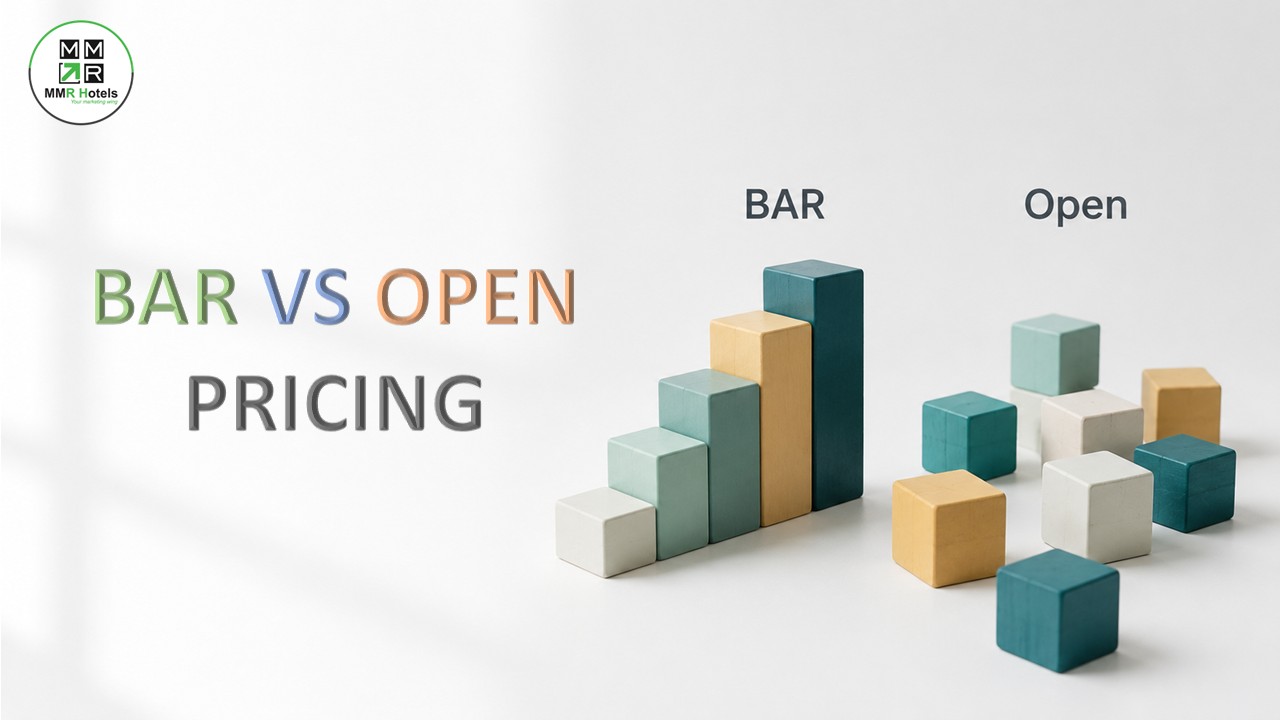
So a hotel sets a BAR for each date. Everything else, corporate rates, OTA rates, promotional rates, gets derived from that one number. Usually as a discount off it. Corporate might be BAR minus twelve percent. A flash sale might be BAR minus twenty. The base moves, and all the derived rates move with it because they are pegged to it.
Simple to run. That is genuinely its biggest strength, and I do not want to undersell it.
How BAR pricing works day to day
Picture a revenue manager, or more realistically at a mid-size Indian hotel, the front office manager who got handed pricing because nobody else would do it. They open the extranet on Monday morning. Coffee going cold because a group inquiry came in at the wrong time. They look at the next fourteen days, decide demand looks soft on the coming Tuesday and Wednesday, and drop the BAR by four hundred rupees on those two dates.
That single move ripples out. The corporate rate drops because it is BAR minus a percentage. The OTA rate drops because the channel manager pushes the new BAR to MakeMyTrip, Goibibo, Booking, all of it. The advance-purchase rate drops. One edit, everything downstream updates.
Corporate rate    = BAR - 12%
OTA rate          = BAR (parity)
Advance purchase  = BAR - 15%
Weekend uplift    = BAR x 1.15
Festival premium  = BAR x 1.40
Tiers sit in the rate calendar as multipliers or fixed offsets, set once and left mostly alone. The BAR underneath them does the daily work.
The catch, and it is a real one, shows up when different room types or different channels want to move in different directions. BAR does not let them. Everything is chained together.
Where BAR pricing genuinely earns its keep
Small teams. This is the honest answer. If your entire revenue function is one person who also handles OTA disputes and the occasional angry guest, BAR is a mercy. One number to think about. You can run a fifty-room property on BAR with a spreadsheet and a channel manager and sleep fine.
Lean teams, uniform inventory, and easy auditing. When a corporate client asks "what's my rate," you answer in one line. If a rate looks wrong, you check the BAR and the offset and you have found the problem in about ninety seconds. With more complex models, that same hunt can eat an afternoon.
For hotels with fairly uniform inventory, say a business hotel where a deluxe and a superior are almost the same room with a different bedsheet, BAR barely costs you anything. The rooms want to be priced together anyway.
Where BAR pricing quietly bleeds money
Now the part that gets uncomfortable.
BAR treats your inventory as one bucket that moves together. Your suites might be selling out for a wedding while your standards sit half empty. Drop the rate to move those standards, and your suites drop too. You just discounted rooms that were about to sell at full price. Nobody decided to do that. The model did it for you.
Channel is the other leak. OTAs cost you commission. A booking on your own site is worth more to you than the same booking through an OTA at fifteen to twenty-two percent commission. Under strict BAR logic, both channels show the same base rate, so you have no clean structural way to reward the direct booking without breaking parity rules or building workarounds.
And the pace of it. BAR moves in whole steps, the base for the whole date. Fine-grained demand, the kind where Thursday night suites are hot but Thursday night standards are not, gets flattened. You are pricing with a broom when the situation wants a brush.
I have watched properties run tight, disciplined BAR strategies and still underperform a scrappier competitor next door, purely because the competitor could price the pieces separately. Not always. But often enough that it stopped surprising me.
Which is more or less the problem open pricing was built to solve.
What open pricing is
Open pricing throws out the single-derived-rate idea entirely. Every room type, every channel, every rate plan, and every date can be priced independently. Nothing is chained to a base. If your deluxe rooms are hot and your suites are cold on the same Saturday, you price the deluxe up and the suite down, at the same time, and neither one drags the other.
The name comes from the freedom. Prices are "open" rather than fixed to a formula. It grew out of airline-style revenue thinking, where a plane has fare classes that fill and close independently, and someone eventually asked why hotel rooms could not work the same way.
It is not magic. It is more surface area to manage. Every room type you can price separately is another number that needs a reason behind it. Which is exactly why it lives or dies on the system running it.
BAR vs open pricing, side by side
| Dimension | BAR pricing | Open pricing |
|---|---|---|
| Core logic | One base rate, everything derived from it | Each room type and channel priced independently |
| Granularity | Property-level moves | Cell-level moves (room type x channel x date) |
| Team needed | Small, even one person | Requires RMS support and someone who reads pace |
| Reaction speed | Whole-ladder steps | Fine, per-segment adjustments |
| Best fit | Uniform inventory, lean teams | Varied inventory, mixed demand, commission-sensitive |
| Main risk | Discounting strong inventory to move weak | Complexity, over-tuning, RMS trusting bad data |
That table flattens a lot of nuance, so treat it as the shape of the thing, not the full picture.
BAR vs open pricing, side by side
| Dimension | BAR pricing | Open pricing |
|---|---|---|
| Core logic | One base rate, everything derived from it | Each room type and channel priced independently |
| Granularity | Property-level moves | Cell-level moves (room type x channel x date) |
| Team needed | Small, even one person | Requires RMS support and someone who reads pace |
| Reaction speed | Whole-ladder steps | Fine, per-segment adjustments |
| Best fit | Uniform inventory, lean teams | Varied inventory, mixed demand, commission-sensitive |
| Main risk | Discounting strong inventory to move weak | Complexity, over-tuning, RMS trusting bad data |
That table flattens a lot of nuance, so treat it as the shape of the thing, not the full picture.
A real-ish revenue simulation
Let me put numbers on it, because abstractions do not convince anyone who signs the cheques.
Take a 60-room hotel: 40 standard, 15 deluxe, 5 suites. A Saturday in wedding season. Demand is lumpy. Suites are gone by Wednesday because of a booking. Deluxe is filling steadily. Standards are lagging.
Under BAR, the manager sees overall occupancy tracking okay but standards soft, so they drop the BAR by 500 to push standards. Result: standards move, sure, but the 15 deluxe rooms that were selling fine just lost 500 each, and the suites, already sold, would have lost 500 too if they were not already booked. Say deluxe sells out anyway.
Wasted discount = rooms that never needed it x discount depth
                = 15 deluxe x 500
                = 7,500 given away on one night
Under open pricing, you drop only the standards by 500, hold deluxe steady, and nudge suite-adjacent inventory up because suite demand signaled strength. Same standards sold. Deluxe margin protected. That 7,500 stays in the account.
Stack that across sixty nights of a busy season and the difference is not a rounding error. It is a renovation budget.
Now, does it always play out this cleanly? No. If your demand really is uniform across room types, BAR loses nothing and open pricing just adds work. The simulation only bites when your inventory pulls in different directions, which for most hotels with a real mix of room types, it does, more often than owners assume.
Which hotels should stay on BAR
Small properties with lean teams and similar room types. If you run thirty rooms that are basically the same room, and your "revenue team" is you plus a channel manager subscription, open pricing is overhead you will not recover. BAR is not a compromise for you. It is the right tool.
Open pricing feeds on clean historical pickup data. If your booking records are a mess, or you switched PMS eighteen months ago and lost continuity, an RMS will make confident decisions off garbage inputs. Confident wrong pricing is worse than simple right pricing. Fix the data first. Then reconsider.
And genuinely uniform-demand hotels: highway transit properties, some budget chains, places where every room sells to the same kind of guest for the same kind of reason. The granularity of open pricing has nothing to grip on there.
Which hotels should move to open pricing
Varied inventory that behaves differently (suites vs standards vs family rooms, each with its own demand curve). Real channel spread where OTA commission is chewing margin. Wild leisure seasonality where demand changes shape, not just level. And the plateau: a good, disciplined team whose ADR just will not climb further, usually because the model has run out of precision.
Varied inventory is the first flag. Multiple room categories that behave differently, suites versus standards versus family rooms, each with its own demand curve. That variance is exactly what open pricing monetizes.
Properties with real channel spread. If you are pushing volume across five OTAs plus your own site plus a corporate portal, and OTA commission is chewing through your margin, open pricing lets you price the direct channel to actually be worth defending.
Resorts and leisure properties with wild seasonality tend to benefit a lot, because their demand does not just move up and down, it changes shape. And any hotel that has hit a ceiling on BAR, where the team is already good and disciplined but ADR just will not climb further, usually because the model has run out of precision. That plateau is often the real signal it is time.
Moving from BAR to open pricing without breaking things
Do not flip the switch overnight. I have seen a property try that and spend three weeks firefighting rate disparities that scared their OTA account managers half to death.
- 1Clean the dataAt least twelve months of reliable pickup history by room type, if you can get it.
- 2Unchain channels firstLet direct and OTA price with a real gap instead of a pegged offset. Watch it for a few weeks.
- 3Unchain room typesLet suites and standards move independently. Then layer in booking-window logic.
- 4Bring in the RMSOnce the structure can handle it, not before. An RMS on messy manual rates just automates the mess faster.
- 5Set guardrailsFloor and ceiling rates. Without them you sell a suite for less than a standard at 2am on the night a regular corporate guest is checking.
The whole transition, done properly, is a quarter, not a weekend.
Common mistakes and a couple of myths
The biggest myth: that open pricing is just "advanced BAR." It is not a tuning of BAR, it is a different structure. Treating it like BAR-with-extra-steps is how teams end up with all the complexity and none of the gain.
Second myth: that open pricing means constant manual work. Done right, it is less manual than people fear, because the system carries the load. The manual part is judgment, not data entry.
Discounting the whole ladder to move one weak segment (the BAR trap, carried into open pricing where it defeats the point). Removing rate floors and getting burned. Trusting the RMS blindly for the first month instead of watching what it does. And parity panic: teams so scared of parity issues they refuse to price channels differently at all, which quietly hands the whole benefit back.