A decade ago, revenue management in Indian hotels was almost entirely an in-house function, and often only at larger chains. An independent 60-room property in Pune or a resort in Coorg did not have a dedicated revenue manager. The GM set rates based on experience, OTA listings were managed by whoever had time, and performance data lived in monthly reports nobody could fully act on.
That has changed. Revenue management companies now work with independent hotels, small chains, heritage properties, resorts, and government hospitality portfolios across India, delivering the function as a managed service rather than a headcount hire. The category has matured enough that choosing the right partner has become a real evaluation process rather than a default selection.
What Hotel Revenue Management Companies Actually Do
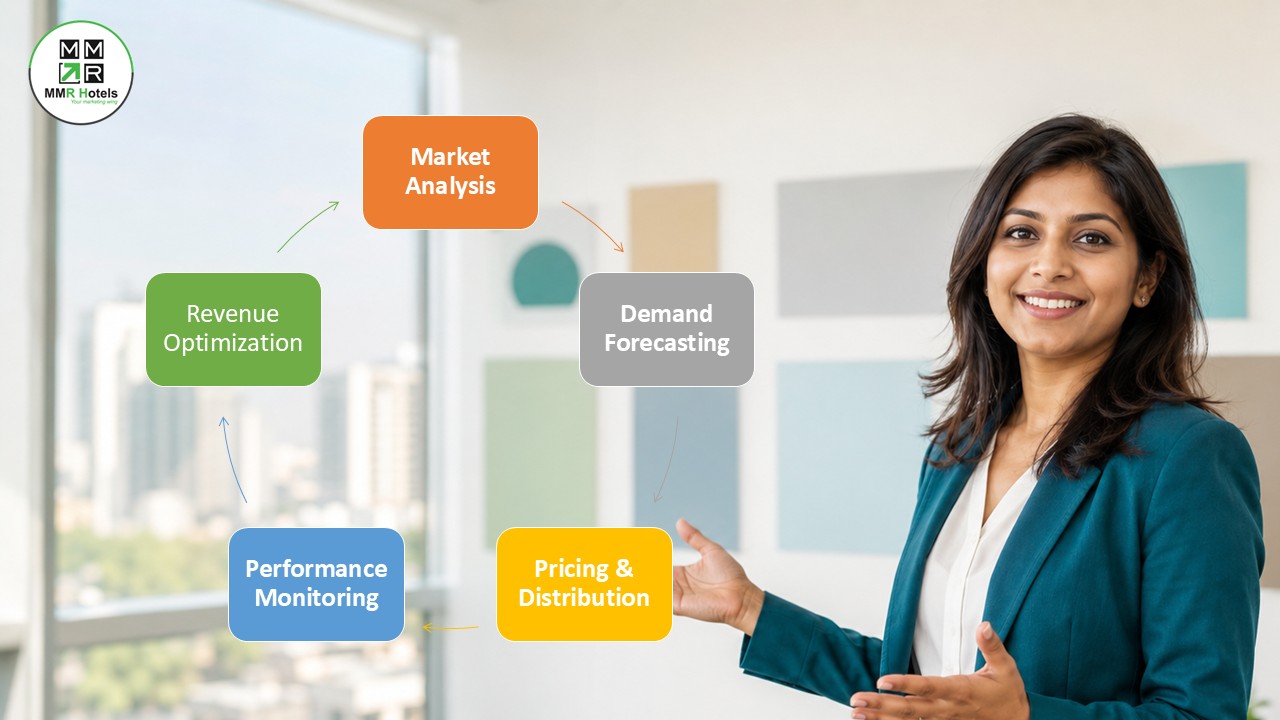
The name covers a range of services. At one end, some companies primarily operate revenue management software and provide light advisory support around it. At the other end, fully managed service providers take over the entire commercial function: OTA listing management, rate strategy, channel mix optimisation, direct booking development, reputation monitoring, and performance reporting.
The core deliverables of a well-run revenue management engagement typically include:
| Service Area | What It Covers | Impact on Hotel |
|---|---|---|
| OTA Optimisation | Listing completeness, photo standards, amenity tagging, content score management across Booking.com, MakeMyTrip, Agoda, Goibibo, Expedia | Improved search visibility, higher click-through rate, better conversion from listing to booking |
| Rate Strategy | Dynamic pricing calibrated to demand signals, comp set monitoring, BAR management, promotional programme evaluation | Higher ADR on demand dates, better RevPAR across the full year |
| Channel Mix | Distribution channel performance analysis, direct booking development, OTA commission cost reduction | Improved NRevPAR and GOPPAR through lower acquisition cost per booking |
| Reputation Management | Review monitoring, response management across platforms, score trend tracking, guest feedback integration into operations | Improved OTA review scores, better ranking, stronger pricing power over time |
| Performance Reporting | Monthly dashboards with ADR, RevPAR, GOPPAR, channel mix, review score, OTA ranking, and comp set benchmarking | Management visibility into what is driving or constraining commercial performance |
Two Service Models: Software vs Fully Managed
The company provides a revenue management system with some advisory support. The hotel team uses the software and implements recommendations. Lower cost, higher internal time commitment, suitable for properties with a capable in-house team that needs better tools rather than external expertise.
The company takes responsibility for the revenue management function entirely: OTA management, rate decisions, channel strategy, reputation monitoring, and reporting. The hotel team focuses on operations while the revenue management partner handles commercial performance. Higher cost, lower internal time requirement, suitable for properties without a dedicated revenue manager or with a GM who cannot give commercial management the attention it needs.
If the GM or owner is spending more than 6 to 8 hours per week on OTA management, rate decisions, and review responses, and those tasks are still not being done consistently, a fully managed model recovers that time and typically improves results simultaneously. If the property already has a capable revenue manager who needs better data and tools, a software-led engagement is more appropriate and less expensive.
What to Look for in a Revenue Management Partner
The quality of revenue management services in India varies considerably. Some providers have genuine expertise in Indian OTA dynamics, domestic demand patterns, and the specific challenges of independent hotel distribution. Others apply generic international frameworks that don't account for MakeMyTrip and Goibibo's role in the domestic market, or the seasonal patterns specific to tier-2 Indian leisure destinations.
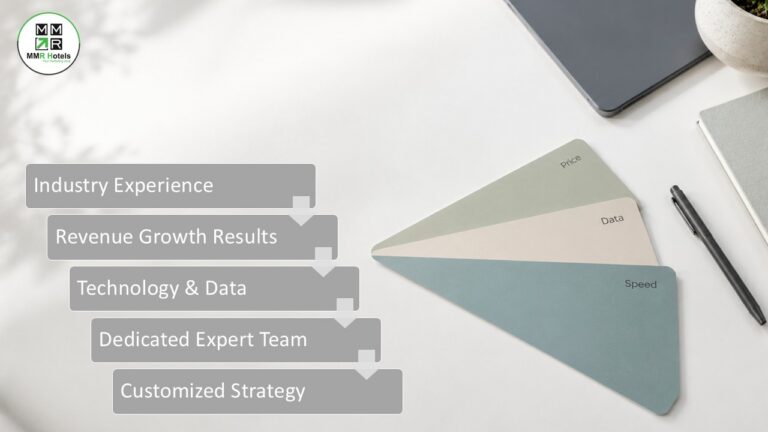
The factors that separate effective partners from average ones:
India-specific market knowledge. A partner who treats Booking.com as the dominant OTA for every Indian hotel type is missing the picture. MakeMyTrip and Goibibo dominate domestic leisure demand for most non-metro properties. The right channel strategy depends on the specific property type, location, and guest profile, not a template applied from international hospitality consulting.
Direct access to the people doing the work. Some revenue management companies have a senior team that pitches the engagement and a junior team that executes it. Ask who will be working on the account week to week, what their experience level is, and what their specific portfolio looks like.
Transparent performance reporting. A partner who cannot show you month-on-month ADR movement, OTA-specific conversion rates, review score trends by platform, and channel mix shift over time is not managing performance. They are providing a service you cannot evaluate.
Questions to Ask Before Signing
- 1 What is your portfolio in properties similar to ours?Not just total properties managed. Properties of similar size, category, and location type. The challenges of a heritage resort in Rajasthan are different from a business hotel in Hyderabad.
- 2 What results have you achieved with comparable properties?Ask for specific ADR improvement, RevPAR improvement, and review score change over a 12-month engagement. Not testimonials. Numbers.
- 3 Who specifically will manage our account?Name, experience level, portfolio size. How many properties does the person managing the account handle simultaneously? Above 15 to 20, attention is thinly spread.
- 4 What does monthly reporting look like?Ask to see a sample report from a current client (anonymised). If the report is a single-page summary, the depth of analysis is shallow. If it includes OTA-level data, pickup analysis, comp set benchmarking, and review score trends, the work is being done properly.
- 5 What is the engagement structure and exit terms?Minimum contract length, notice period, what happens to OTA accounts and data if the engagement ends. These details matter and responsible providers are transparent about them.
What Results to Expect and When
OTA listing improvements and availability corrections typically produce visible impact within 2 to 4 weeks. Rate optimisation improvements appear in ADR data within 4 to 8 weeks. Review score improvements take 3 to 6 months because they depend on operational changes and review velocity building. Direct booking share improvements take 6 to 12 months of consistent effort.
A realistic 12-month outcome for a well-managed engagement on an independent Indian hotel that starts with basic OTA performance: ADR improvement of 8 to 18%, RevPAR improvement of 10 to 22%, review score improvement of 0.3 to 0.8 points on a 10-point scale, and direct booking share movement of 5 to 15 percentage points. These are planning ranges, not guarantees. Properties with more significant starting gaps typically see larger improvements.
Call two references from the company's current client portfolio — properties similar to yours in size and type. Ask them directly: what changed in the first 90 days, what took longer than expected, and what they wish they had asked before starting. That conversation is worth more than any sales presentation.