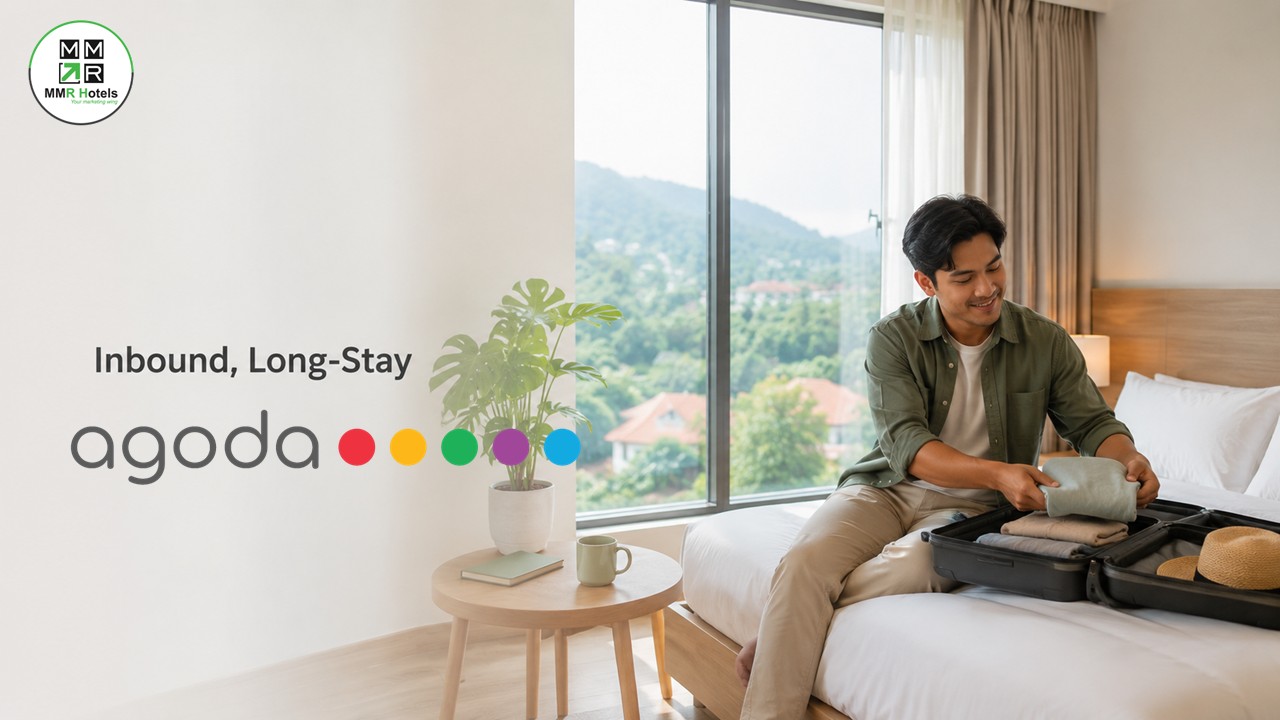
Check where your Agoda guests actually come from before deciding how much the channel deserves. For a property we manage in South Goa, one January the Agoda mix was Singapore, Bangkok, Seoul, and a surprising amount of Taiwan. Average stay just under four nights. The MMT guest that month averaged 1.8 nights. Same rooms, very different economics.
Agoda's centre of gravity is not India
It is Asia-Pacific, which is exactly the point. Agoda is often the default booking app for travellers from Southeast and East Asia the way MMT is for Indians. If your market sees any inbound Asian traffic (Goa, Kerala, the Golden Triangle, Buddhist circuit towns like Bodh Gaya, business cities with East Asian corporate movement), Agoda is your storefront to that demand, and its bookings arrive with longer lead times and longer stays than domestic OTA traffic.
The YCS extranet rewards attention
Agoda's extranet (YCS) surfaces a price competitiveness view that compares your Agoda rate against your rates elsewhere. This is worth checking weekly, tedious as it is, because Agoda's algorithm visibly punishes listings it perceives as worse-priced than the same room elsewhere. Parity slippage that MMT might shrug at will cost you rank here within days.
Typical shape of the channel at inbound-exposed properties we manage. Illustrative ranges, not guarantees.
Programmes worth the margin, and one to watch
Agoda's promotion stack is deep: secret deals for logged-in users, country-targeted campaigns (discount only to travellers browsing from, say, South Korea), long-stay rates, and the AGP growth programme trading commission for placement. Country targeting is the underused one. Discounting 12 percent only to the markets you want more of costs far less than a flat public cut, and it shapes your guest mix instead of just your price.
The one to watch is blanket enrolment in every programme at once. Stacked discounts compound quietly, and Agoda will happily let a 10 percent deal sit on top of a 15 percent campaign on top of a mobile rate.
Loading Agoda with domestic-OTA thinking: aggressive last-minute discounts and short-stay pricing. Agoda's guest books weeks out and stays longer. Last-minute panic pricing here mostly gives margin to guests who booked the room mentally a month ago.
Content for a guest who has never seen your city
Write the listing for someone landing at the airport with no context. Distance to landmarks in minutes, not kilometres. Airport transfer options and cost in rupees. Which room type suits a four-night stay with luggage. English descriptions checked by someone who actually speaks it; auto-translated Hindi-English hybrid text reads as risk to an inbound guest comparing five unfamiliar properties at midnight in another timezone.
- 1Pull your Agoda guest-origin reportKnow which countries book you before touching promotions.
- 2Fix parity for Agoda's algorithmCheck the YCS competitiveness view weekly; it is less forgiving than domestic platforms.
- 3Target countries, not the calendarUse origin-specific deals to shape mix. MMR's audit shows where your inbound headroom is.