

What Is the Direct Booking Funnel?
The direct booking funnel describes the journey a guest takes from first learning a hotel exists to completing a booking on the hotel's own channel, and eventually returning for a second and third stay without the OTA's involvement. It is not a single action or a single technology. It is a connected sequence of touchpoints that the hotel either manages actively or cedes to OTAs by default.
Every hotel already has a version of this funnel, whether or not it's been designed. Guests are discovering the property, forming impressions, visiting the website, and making booking decisions on some channel. The question is not whether the funnel exists but whether the hotel is present and competitive at each stage or absent and letting OTAs fill the gaps.
| Funnel Stage | Guest Action | Hotel's Role | OTA's Competing Action |
|---|---|---|---|
| Awareness | Becomes aware the property exists | Build brand recognition through owned channels | OTA listing appears in category search results and branded email campaigns featuring the property |
| Google Search | Searches for the hotel by name or by category | Appear first in brand search results; compete on category searches through SEO and Google Hotel Ads | OTAs bid aggressively on hotel brand keywords and dominate category search results pages |
| Google Business Profile | Views the hotel's Google card with photos, reviews, and booking options | Maintain current GBP with direct booking link and active Google Hotel Ads | OTA rates appear alongside the hotel's direct rate in Google Hotel Ads |
| Hotel Website | Visits the hotel's own website to research | Present a compelling case for direct booking at least as convincing as the OTA listing | OTA listing is often more complete, faster to load, and easier to navigate than the hotel website |
| Booking Engine | Enters booking engine to check rates and complete the transaction | Convert the visit through a smooth, fast, mobile-friendly booking experience | OTA checkout is familiar, trusted, and optimised from years of conversion testing |
| Post-Booking | Receives confirmation, pre-arrival communication, stays, and receives post-stay follow-up | Build a direct relationship that makes the OTA irrelevant for future bookings | OTA manages confirmation and sends its own pre-arrival and loyalty communications |
A 40-room hotel generating INR 80 lakhs in annual room revenue with 25% direct booking share and 75% OTA share at 17% commission pays approximately INR 10.2 lakhs per year in OTA commission. Moving to 45% direct and 55% OTA, with the same total revenue, reduces that commission to approximately INR 7.5 lakhs. The INR 2.7 lakh annual saving requires no new marketing spend, no additional occupancy, and no rate change. It requires a functioning direct booking funnel that captures guests the hotel was already generating.
Stage 1: Awareness
Awareness is where everything starts. A guest who doesn't know the hotel exists will never book direct. A guest who discovers it through an OTA will, statistically, book through that OTA unless the hotel actively intercepts them at a later stage. Building awareness through channels the hotel controls is the most upstream investment in the direct booking funnel and the one with the longest payback period, which is why most hotels don't do it.
How Awareness Currently Works for Most Independent Hotels
For most independent properties in India, awareness is almost entirely OTA-mediated. The hotel appears in Booking.com, MakeMyTrip, and Agoda search results when guests search for accommodation in the destination. Guests who didn't know the hotel existed before that search now know it. And they book through the OTA that showed it to them. The hotel's awareness spend is zero. The cost is 15 to 20% on every booking that results from that discovery.
Building Owned Awareness
Owned awareness means a guest learns about the hotel through a channel the hotel controls before they initiate a search. Instagram and Google Business Profile are the two highest-return owned awareness channels for most independent Indian hotels. Neither requires a large marketing budget. Both require consistent attention.
Instagram works for properties that are visually distinctive: heritage hotels, boutique properties, resorts with strong natural settings, rooftop restaurants. A hotel that posts 3 to 4 times per week with genuine content, not stock photography, and engages with comments builds a following that generates direct search traffic. The conversion path is: Instagram content → brand search on Google → direct booking. A guest who found the hotel through Instagram and then searched it by name is worth more per booking than one who found it through an OTA category search: they arrived with brand intent, which produces higher conversion on the direct booking channel.
| Awareness Channel | Cost | Lead Time to Impact | Best For | Direct Booking Connection |
|---|---|---|---|---|
| Instagram / Social Media | Staff time, content production | 6–18 months to meaningful brand search volume | Visually distinctive properties: boutique, heritage, resort | Builds brand search volume that arrives at the hotel website, not OTAs |
| Google Business Profile | Free: time to maintain | Immediate for existing searches; ongoing for new | All property types | Direct booking button on GBP card captures brand searchers before OTA result |
| Travel Content / SEO | Content production cost | 6–12 months for organic rankings | Properties in destinations with active travel content search | Category searchers (not brand searchers) reach hotel website through organic content |
| Word of Mouth / Referral | Zero direct cost | Immediate per referral | All property types | Referred guests typically search by name, arriving at hotel website or GBP directly |
| Past Guest Re-Engagement | Email platform cost: negligible | Immediate per campaign | Properties with a direct booking guest database | Highest-converting awareness for repeat bookings: guest already has the hotel in mind |
Stage 2: Google Search and Stage 3: Google Business Profile
These two stages sit together because they are inseparable in the guest experience. A guest searching the hotel name on Google sees the Google Business Profile card and Google Hotel Ads on the same results page. Whether they click through to the hotel website or to an OTA is determined in this 10-second window. The hotel that wins this moment converts a motivated, brand-aware guest at the lowest possible acquisition cost. The hotel that loses it pays OTA commission on a guest who came looking for them specifically.
The Brand Search Interception Problem
When a guest searches "The Blue Banyan Rishikesh" on Google, the ideal outcome is: the hotel's website appears first organically, Google Hotel Ads shows the hotel's direct rate at the top, and the guest books directly. The common reality: Booking.com, MakeMyTrip, and TripAdvisor appear above the hotel's website in organic results. OTA rates appear in Google Hotel Ads alongside or above the hotel's own rate. The guest who came to book direct is now comparing the hotel's direct rate against OTA rates on the OTA's own platform before the hotel website even loads.
OTAs systematically bid on hotel brand keywords in Google Ads because the cost per click is low (limited competition) and the conversion rate is high (these are motivated brand searchers). A hotel that doesn't actively manage its Google presence is paying OTA commission on bookings that arrived with brand intent and should have converted directly.
Google Business Profile Optimisation
The Google Business Profile is often a guest's first visual impression of the hotel on Google. It should show: the best current photos (updated after every renovation), a direct booking link as the primary CTA, the accurate phone number and address, current opening hours for any restaurant or spa, and responses to all Google reviews. An unclaimed, incomplete, or photo-outdated GBP is a missed direct booking opportunity at every brand search.
| GBP Element | Current State (Common Gap) | What Good Looks Like | Direct Booking Impact |
|---|---|---|---|
| Photos | 5 to 8 photos uploaded at setup, never updated | 25+ photos covering all major areas, updated within 6 weeks of any renovation | High: GBP photos appear in Google search results image strip before the website loads |
| Reviews | Google reviews largely unanswered. Some negative reviews with no response. | Every review responded to within 5 days. Negative reviews acknowledged specifically and professionally. | Medium: review score and responses visible in GBP card affect brand search conversion |
| Direct Booking Link | Website link goes to homepage only, with no booking button visible above fold | "Book direct" button linked directly to the booking engine or a landing page with direct booking CTA above fold | High: this is the primary conversion mechanism from brand search to direct booking |
| Google Hotel Ads | Not active: only OTA rates appear in Hotel Ads | Hotel's direct rate appears alongside OTA rates in Google Hotel Ads, visible to any guest searching the brand name | Very high: direct rate visibility at the moment of brand search converts motivated guests before they reach OTA listing pages |
Google Hotel Ads
Google Hotel Ads shows a hotel's direct rate alongside OTA rates when guests search for the property name or for accommodation in the destination. For brand searches specifically, Google Hotel Ads is the single highest-return direct booking investment available to most independent hotels. The CPC (cost per click) on a hotel's own brand name is low because few advertisers compete for it. The conversion rate from these clicks is high because the guest arrived with brand intent. The effective acquisition cost per booking through Google Hotel Ads on brand keywords is typically 6 to 10%, which is significantly below any OTA commission rate.
The integration requires: a booking engine connected to Google Hotel Ads, a Google Merchant Center account, and a minimum daily budget. Most booking engine providers offer Google Hotel Ads connectivity as a standard feature. Setup time is typically 3 to 7 days. The investment is not significant; the decision to get it done usually is.
Stage 4: Hotel Website
The hotel website has one job in the direct booking funnel: convince a guest who arrived there to book direct rather than navigate back to an OTA. It fails at this job more often than any other stage in the funnel, and usually for the same handful of reasons.
Why Guests Leave Hotel Websites for OTAs
The OTA listing that a guest came from was faster to load, had more photos in a cleaner gallery, showed clear policies in a readable format, and completed the booking in 4 steps with a payment method the guest already had saved. The hotel website was slower, had fewer photos, required the guest to find the "Book Now" button after reading a hero banner about the property's award from 2019, and loaded a booking engine that didn't show UPI as a payment option. The guest made a rational decision.
The hotel website doesn't need to be better than Booking.com in general. It needs to be better than the Booking.com listing for this specific property. That is a much smaller problem. The Booking.com listing is limited by the OTA's format. The hotel website can offer anything: a full local area guide, the owner's story, seasonal content, package builder, direct contact via WhatsApp, and the specific reasons to book direct prominently placed.
What the Hotel Website Must Do in the First 5 Seconds
A guest who arrives from a brand search on mobile gives the hotel website approximately 5 seconds before deciding to engage or leave. In those 5 seconds, the page needs to load fully (under 3 seconds), show the property at its best (first impression visual), and communicate a reason to book here rather than returning to the OTA. Not a subtle reason. An explicit, specific, visible reason.
| Homepage Element | What Most Hotels Do | What Converts |
|---|---|---|
| Hero Section | Large background photo, property name, generic tagline ("Experience Luxury") | Best property photo, direct booking benefit stated explicitly ("Book direct: complimentary breakfast included"), Book Now button visible without scrolling |
| Direct Booking Incentive | Absent, or buried in the footer as a small-text "best rate guarantee" | Prominent, specific: "Book on our website for: complimentary breakfast / flexible cancellation / room upgrade subject to availability." Visible on the homepage and on every page near the booking button. |
| Rate Transparency | No rates on the homepage; guest must go to booking engine to see any price | Starting rate displayed (optional but effective for price-sensitive decisions): "Rooms from INR 3,800 per night including breakfast" reduces the rate uncertainty that sends guests back to OTAs. |
| Social Proof | No reviews visible on the website, or a static quote from 2021 | Dynamic Google review feed or selected recent reviews with dates. Guests from brand searches already trust the property but need reassurance that recent guests did too. |
| Contact Options | Contact page with email form that responds in 24 to 48 hours | WhatsApp button visible on every page. Indian guests prefer WhatsApp for pre-booking questions. A response in 10 minutes converts uncertainty to booking. A 24-hour email response doesn't. |
Mobile Speed Is Not Optional
Over 65% of hotel website visits in India happen on mobile. A website that takes 6 to 8 seconds to load on a mobile connection loses a significant proportion of those visitors before they see a single photo. Google PageSpeed Insights gives a free mobile speed score. Any score below 70 for mobile is a direct booking problem. The most common causes of slow hotel websites: large uncompressed images (the single most common issue), third-party scripts loaded synchronously, and shared hosting that can't handle traffic spikes. All are fixable without a website rebuild.
Stage 5: Booking Engine
The booking engine is where direct booking intent either converts or abandons. A guest who reached the booking engine has already decided to consider booking direct. What causes them to leave and return to an OTA is not usually price at this stage: it's friction. Slow loading, confusing interface, unexpected fees at checkout, or a payment method that isn't available.
What a Good Booking Engine Does
A well-configured booking engine for an Indian independent hotel should: load in under 2 seconds on mobile, show real-time availability for all active room types, display the direct booking incentive (breakfast, upgrade, flexible terms) clearly on the room selection page, show the full price including taxes before the payment step, and complete the booking in 4 to 5 steps maximum. Every additional step reduces conversion. Every moment of loading uncertainty sends the guest back to the OTA tab they still have open.
Rate Display and Price Transparency
One of the most common direct booking conversion failures: a guest selects a room at INR 4,500, proceeds to checkout, and the total shows INR 5,310 after GST and a "property fee." They return to Booking.com, which showed INR 4,500 total (inclusive) from the beginning. The guest's perception is that the hotel website showed a misleading price. The reality is that both prices are the same after adding taxes, but the display timing created a trust problem. Show the fully inclusive price from the room selection page. Any surprise at checkout loses a disproportionate share of bookings.
Booking Engine Selection Criteria
| Criterion | Why It Matters | What to Check |
|---|---|---|
| Mobile Performance | Majority of hotel website traffic in India is mobile. Slow or non-responsive booking engine loses the majority of visitors before booking. | Complete a test booking on the engine from a mobile phone on a standard 4G connection. Count the seconds between each step. |
| Payment Methods | UPI, net banking, credit card, debit card, and EMI for higher-value stays are standard expectations for Indian guests. Missing any of these loses bookings at the final step. | Check which payment methods appear at checkout. Confirm UPI is available. Check whether EMI is offered for stays above INR 8,000. |
| Google Hotel Ads Integration | Connecting the booking engine to Google Hotel Ads is the mechanism that puts the hotel's direct rate in Google search results. Without this integration, Google Hotel Ads cannot be activated. | Ask the booking engine vendor: is Google Hotel Ads integration included? Is there an additional fee? How long does setup take? |
| Channel Manager Integration | Direct bookings must immediately reduce inventory on all connected OTAs. Without channel manager integration, a direct booking can cause an overbooking if the same room is booked on an OTA before the channel manager is manually updated. | Confirm the booking engine is directly integrated with the channel manager, not just connected to the PMS with a separate manual step. |
| Upsell Capability | A booking engine that can offer room upgrades, breakfast add-ons, or spa credits during the booking flow improves direct booking TRevPAR beyond the room rate alone. | Check whether the engine supports add-on offers during booking. A room upgrade offer at 20% below the direct upgrade rate converts at 8 to 12% and improves ADR per direct booking. |
Do this once a month: open the hotel's booking engine on a mobile phone as a guest. Select dates, choose a room, proceed through checkout to the payment page. Time each step. Count the total steps. Note the moment where you'd consider abandoning. Whatever that moment is, it's happening to guests too. This test takes 8 minutes and consistently surfaces conversion problems that no amount of website analytics reporting makes as obvious.
Stage 6: Payment and Confirmation
Payment
Payment is where a motivated, engaged guest who has completed every prior step either converts or abandons. The abandonment at this stage is different from earlier stages: the guest wanted to book. Something specific about the payment experience stopped them. In India, the most common causes are a missing UPI option, an unfamiliar third-party payment gateway that takes 15 seconds to load, a session timeout that loses the entered data, or an EMI option not available for a INR 12,000 peak-season booking.
The UPI gap specifically affects a large share of Indian guests under 35. This demographic books heavily on mobile and uses UPI as a primary payment method. A hotel booking engine without UPI is requiring a segment of motivated buyers to use a payment method that is not their preference, and losing a proportion of them in the process. The fix is not complicated: most payment gateways in India (Razorpay, PayU, Cashfree) support UPI natively. The booking engine must be configured to offer it at checkout.
Lost Revenue = Monthly Booking Engine Sessions × Conversion Rate Gap × Average Booking Value Example: 600 monthly booking engine sessions, current conversion 2.1%, potential conversion with UPI added 2.8%. Gap: 0.7%. 600 × 0.007 = 4.2 additional bookings per month. At INR 5,500 average booking value: INR 23,100 per month in recovered revenue from one payment method addition. Annual: INR 2.77 lakhs.
Confirmation
The confirmation email arrives at the highest-engagement moment in the post-booking journey. The guest just made a decision. The confirmation either reinforces that the decision was good or treats it as an administrative closure. Most hotel confirmation emails are the latter: a transaction receipt with dates, room, rate, and cancellation policy. Nothing more.
A confirmation email that adds value at this moment: expresses genuine welcome (a single specific sentence about what makes this property worth choosing, not a generic "we look forward to welcoming you"), provides the direct WhatsApp number for pre-arrival questions (this reduces pre-arrival enquiries through the OTA messaging system and reinforces the direct relationship), and includes one piece of local information the guest can act on immediately (a recommendation for dinner on arrival night, a note about the best time to visit the local landmark). These additions take 30 minutes to set up once as an automated template and make every direct booking confirmation feel like a personal communication rather than a system-generated receipt.
Stage 7: Pre-Arrival
Pre-arrival is where the direct booking relationship begins to diverge from the OTA booking relationship in a way that matters financially. A direct booking guest shares their email and phone with the hotel directly. The hotel can contact them before arrival through its own channels. An OTA guest may have a masked email address and is primarily communicated with through the OTA's messaging system, where the hotel's communication is visible to the OTA and limited in what it can contain.
What Pre-Arrival Communication Should Do
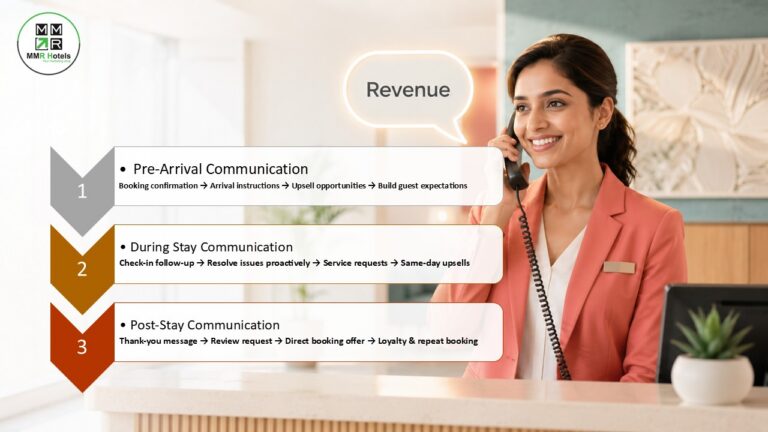
A pre-arrival message sent 5 to 7 days before check-in serves three purposes: it confirms the booking details in a warm, personalised tone (reducing last-minute cancellations from guests who second-guessed their decision), it offers specific ancillary services that improve TRevPAR, and it begins the relationship that makes the guest feel they are arriving at a property that knows them, not at a bed in a generic hotel.
The message should be sent via WhatsApp for Indian guests (higher open rates and response rates than email for domestic travellers), with email as a backup. It should be personalised to the room type booked and the stay length, not generic. A couple booked for a weekend in a Deluxe Room should receive a different message than a family booked for a week in a Family Suite. The personalisation doesn't need to be deep: acknowledging the room type and suggesting one relevant activity ("Since you've booked our Garden View Room, you might enjoy our sunrise yoga session on Saturday morning at no additional cost") signals attention that an OTA booking never receives.
| Pre-Arrival Offer Type | Typical Uptake Rate | Revenue per Accepted Offer | How to Frame It |
|---|---|---|---|
| Room Upgrade (discounted) | 8–15% | INR 500–1,500 incremental per night | "Your Deluxe Room is confirmed. If you'd like to upgrade to our Heritage Suite with a private courtyard, we have one available for INR 800 extra per night." |
| Spa Treatment (specific appointment) | 6–12% | INR 1,200–3,500 per booking | "We have a 60-minute Ayurvedic massage available at 4 PM on Saturday. Would you like to reserve it? INR 1,800 per person." |
| Early Check-In | 15–25% | INR 500–1,000 depending on policy | "Your room will be ready from 2 PM. If you'd prefer early check-in from 10 AM, we can arrange it for INR 700." |
| Airport Transfer | 10–20% | INR 800–2,500 depending on distance | "We can arrange a private transfer from [Airport] for INR 1,200. Let us know your flight details and we'll take care of it." |
| Dinner Reservation | 8–15% | INR 600–2,000 per person | "Our rooftop restaurant has limited tables on Friday evening. Would you like us to reserve one for you at 7:30 PM?" |
Stage 8: The Stay
The stay is the operational core of the direct booking funnel. No amount of pre-arrival optimisation or post-stay communication recovers from a poor guest experience during the stay. The stay is also where the hotel team has the clearest opportunity to turn a first-time direct booker into a repeat direct booker, through one conversation and one piece of information at checkout.
Delivering on Direct Booking Promises
If the hotel's direct booking incentive was complimentary breakfast, the breakfast must be noticeably good, delivered without the guest needing to remind staff that it's included, and consistent across days of the stay. If the incentive was a room upgrade, the upgrade must be genuinely better than the booked category in a way the guest can appreciate. A direct booking incentive that requires the guest to chase the front desk to redeem or that is delivered so quietly the guest didn't notice it produces a weaker recall of the direct booking advantage on their next trip planning.
The Checkout Conversation
Booking.com's terms prevent soliciting direct bookings during the stay by offering lower rates to redirect a booking in progress. They do not prevent a natural checkout conversation that mentions the direct booking channel. "We'd love to welcome you back. Next time you stay, booking directly on our website includes complimentary breakfast and guaranteed late checkout. Here's our direct booking card." This takes 20 seconds, complies with OTA terms, and plants the seed that the next booking should be direct. Of all the interventions in the direct booking funnel, this one has the highest conversion rate per interaction because the guest is at peak satisfaction with the stay and maximum consideration of returning. Most hotels never do it.
Front Desk as Distribution Team
The front desk team is, in distribution terms, the hotel's most direct interface with guests at the moments when direct booking conversion is most likely. Training them on the direct booking message, the direct booking incentives, and the one-sentence checkout pitch costs less than a month's Google Hotel Ads budget and produces direct booking conversions that compound over years. This is the operational investment in direct bookings that most revenue management content forgets to mention.
Stage 9: Post-Stay
Post-stay communication is the most underinvested stage in most hotel direct booking programmes. The 48 hours after checkout is when the guest is most likely to leave a review, most likely to recommend the property to others, and most receptive to a future booking offer. Most hotels send no communication at all during this window. The OTA sends a review request. Booking.com wins the review relationship by default.
The Post-Stay Email
A post-stay email sent within 24 to 48 hours of checkout should accomplish four things without feeling like it's trying to accomplish four things. It should: thank the guest genuinely with a specific reference to their stay (the room type or the dates, not "Dear valued guest"), invite a review with a direct link to Google or Booking.com (both are valuable; Google reviews build the GBP presence that feeds direct bookings), include the hotel's direct booking link for a future stay, and note something upcoming at the property that might be relevant to the guest. A Diwali special, a monsoon offer, a new restaurant opening, anything that gives the guest a reason to think about returning specifically rather than generically.
The tone should be a warm note from the team, not a marketing email. The guest should feel that someone at the hotel took a minute to write to them, even though it is a templated message. That effect is achieved by specificity: "We hope you enjoyed your time in the Heritage Suite" reads differently from "We hope you enjoyed your stay with us." One sentence of personalisation transforms a template into a relationship communication.
Review Requests
A post-stay review request from the hotel directly, before the OTA's automated request arrives, improves the hotel's Google review score alongside its OTA score. Google reviews are particularly valuable for the direct booking funnel because they improve GBP prominence and brand search conversion. A hotel with 85 Google reviews at 4.7 stars benefits from direct booking visibility in a way that a hotel with 12 Google reviews at 4.9 stars does not, because volume signals reliability to both potential guests and Google's local ranking algorithm.
The review request should link to Google specifically for guests who booked direct, and to Booking.com or MakeMyTrip for guests who booked through those platforms. Routing guests to the platform where they have an account produces higher review completion rates than asking them to create a new account on an unfamiliar platform.
Stage 10: Repeat Direct Booking
A repeat direct booking is the compounding return on every prior investment in the funnel. The acquisition cost is near zero: an email or a WhatsApp message to someone who already knows and has chosen the property. The conversion rate is the highest in any stage of the funnel. And the financial return, commission saved on every repeat stay, accumulates without any additional marketing investment.
Building a Repeat Guest Database
The repeat direct booking programme starts with a database. The database starts with registration cards. Every guest who checks in should provide their email address and phone number on the registration form, regardless of how they booked. The data belongs to the hotel, not the OTA. A hotel that has been operating for five years and has never systematically collected guest contact information from check-in registration cards has likely interacted with 3,000 to 8,000 guests and retained contact for almost none of them. That is thousands of potential repeat direct bookers who have no mechanism by which the hotel can invite them back directly.
Building the database from today forward: make the email address and phone number mandatory fields on the registration card. Transfer them to a simple spreadsheet or CRM weekly. Within a year, most properties have a database of 400 to 800 contactable past guests. That is the foundation of a repeat direct booking programme.
The Communication Cadence
Three emails per year to past guests is enough for most independent hotels. More than three starts to feel promotional and produces unsubscribes. Fewer than three is too infrequent to maintain consideration between stays.
| Email Type | Timing | Content | Expected Direct Booking Rate |
|---|---|---|---|
| Post-Stay Thank You | 24–48 hours after checkout | Genuine thank you, review request, direct booking link, one upcoming seasonal note | 3–7% same-month rebooking from this email alone |
| Seasonal Offer | 3–4 months after stay, timed to upcoming peak or event season | Relevant seasonal offer: Diwali long weekend, summer holiday package, monsoon retreat offer | 2–5% of recipients booking if the season is relevant to their profile |
| Anniversary Email | 11–12 months after their last stay | "It's been almost a year since your stay" with a specific offer for a return visit in the same season | 3–8%: anniversary timing resonates strongly with leisure and couple segments |
Annual Value = Database Size × Email Response Rate × Average Booking Value × (OTA Commission % − Direct Cost %) Example: 500 past guests, 4% booking rate from seasonal email, INR 6,000 average booking value, 15% OTA commission vs 3% direct cost. 500 × 0.04 = 20 bookings × INR 6,000 = INR 1,20,000 revenue × 12% net cost saving = INR 14,400 in additional retained revenue per email campaign. Two campaigns per year: INR 28,800 in additional retained revenue from a database that cost nothing beyond staff time to maintain.
Measuring the Direct Booking Funnel
Most direct booking measurement stops at: how many direct bookings did we get this month? That number tells you the output of the funnel but nothing about where the funnel is leaking. A structured measurement approach tracks each stage separately so the constraint is identifiable and the fix is specific.
| Funnel Stage | Metric to Track | Tool | Action Trigger |
|---|---|---|---|
| Awareness | Brand search volume trend | Google Search Console | Flat or declining brand search volume: assess whether social media and GBP maintenance is consistent |
| Google Search | Direct traffic from Google to hotel website | Google Analytics | Direct traffic below 30% of total website sessions: Google Hotel Ads not active or brand keyword visibility weak |
| Google Business Profile | GBP views and clicks to website | Google Business Profile Insights | Low clicks-to-website ratio from GBP views: review direct booking link and GBP content quality |
| Hotel Website | Website sessions, bounce rate, time on page | Google Analytics | Bounce rate above 70%: homepage is not providing a reason to engage. Page load time above 4 seconds on mobile: compress images first. |
| Booking Engine | Booking engine sessions and conversion rate | Booking engine analytics | Conversion below 3%: mobile speed test, payment method audit, price transparency check |
| Payment | Payment step abandonment rate | Booking engine analytics or payment gateway reporting | Abandonment above 25% at payment step: add UPI, check gateway load time, verify price consistency |
| Post-Stay | Post-stay email open rate, click rate, review submission rate | Email platform analytics | Open rate below 25%: subject line or sender name needs revision. Click rate below 5%: email content isn't driving action. |
| Repeat Direct | Repeat direct booking rate from past guest database | PMS source-of-booking report cross-referenced with guest database | Repeat direct rate below 5%: increase communication frequency or improve offer relevance in seasonal emails |
- 1 Search the hotel name on Google right nowDoes the hotel website appear before OTA results? Does a Google Hotel Ads rate show for the direct channel? If no to either, these are the first two fixes.
- 2 Complete a test booking on the hotel's own booking engine from a mobile phoneTime each step. Note the first moment you'd consider abandoning. That moment is costing direct bookings every day. Fix it before anything else.
- 3 Set up a post-stay email templateOne email, sent within 48 hours of checkout, with a review request and a direct booking link. This can be live within a week and begins building the repeat guest relationship immediately.
- 4 Start collecting guest emails at check-inAdd email address to the registration card as a mandatory field. Transfer to a spreadsheet weekly. This is the database that will fund the repeat direct booking programme in 12 months.
Technology That Supports the Direct Booking Funnel
| Technology | Funnel Stage It Supports | What It Does | Without It |
|---|---|---|---|
| Booking Engine | Hotel website, payment, confirmation | Converts website visitors to confirmed direct bookings. Connects to Google Hotel Ads for direct rate display in Google search results. | No mechanism for direct bookings. All online bookings go through OTAs by default. |
| Channel Manager | Booking engine integration | Ensures direct bookings reduce OTA inventory immediately, preventing overbookings when the same room is shown on multiple channels. | Direct bookings and OTA bookings managed as separate inventory pools. Overbooking risk on sold-out nights. |
| Google Hotel Ads | Google Search, Google Business Profile | Shows the hotel's direct rate alongside OTA rates in Google search results. Intercepts brand searchers before they reach OTA listing pages. | OTAs win every brand search comparison. Motivated direct bookers are funneled to OTA bookings. |
| CRM / Email Platform | Post-stay, repeat direct booking | Manages past guest database, sends post-stay emails, automates seasonal campaigns and anniversary messages. | Past guest communication is manual (or absent). No repeat direct booking programme. |
| WhatsApp Business | Pre-arrival, stay, post-stay | Direct communication channel with direct booking guests. Higher open rates and response rates than email for Indian guests. Pre-arrival upsell delivery, real-time guest service, post-stay follow-up. | Pre-arrival communication relies on email alone. Lower engagement from domestic Indian guests who prefer WhatsApp. |
| Google Business Profile | Awareness, Google Search | The hotel's Google presence: visible to every brand searcher, feeds Google Hotel Ads, builds organic search presence through reviews and local SEO. | Free tool that most hotels underuse. Neglecting it cedes brand search traffic to OTAs. |
Frequently Asked Questions
Want this set up for your property?
We'll review this against your hotel's current setup, free of charge.