Most hotels that buy a revenue management system do it in one of two ways: they get a recommendation from a colleague at a conference, or a vendor calls at the right moment when rate management has become genuinely painful. Neither process is terrible, but neither produces a particularly good fit. The result is a hotel paying for a system it uses at 30% of its capability while still making key pricing decisions on a spreadsheet.
What a Revenue Management System Actually Does
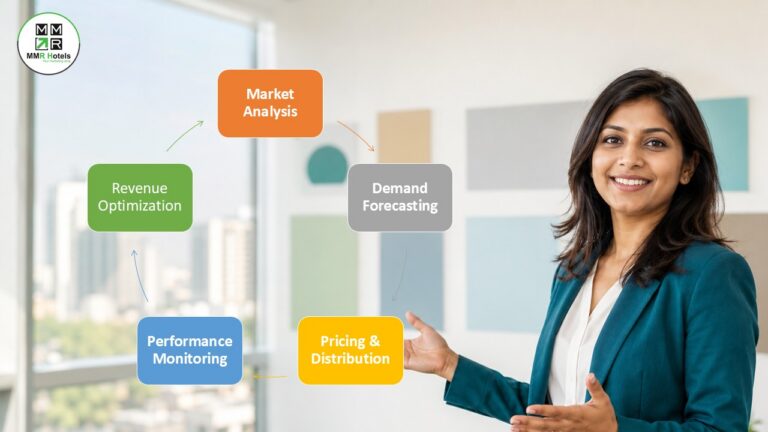
An RMS collects demand signals from multiple sources: the hotel's own booking history, competitor rate data from OTAs, local event calendars, pickup pace by room type, and sometimes external data like flight searches to the destination. It processes these signals and generates rate recommendations for the hotel's room types across the forward booking window.
Basic systems present recommendations for a human to review and approve before publishing. Advanced systems push rate changes directly to the channel manager without human review, based on rules and thresholds the hotel has configured. The difference matters more for properties with many room types, high booking volumes, or significant rate complexity than for small properties making a handful of rate decisions each week.
RMS (Revenue Management System) is software that analyses demand data and generates pricing recommendations for hotel room types across the forward booking window. It ranges from simple rate suggestion tools to fully automated systems that push rate changes to distribution channels without human intervention.
When a Hotel Actually Needs One
Not every property benefits from an RMS investment. A 15-room guesthouse with a simple rate structure and one or two OTA connections can manage pricing effectively with a weekly rate review process and a good channel manager. The complexity doesn't justify the investment.
The point at which an RMS starts paying for itself is roughly when manual rate management is taking more than 3 to 4 hours per week, or when rate decisions are consistently lagging market conditions because the team doesn't have time to review them frequently enough. Properties where this is true: 40 or more rooms with multiple room types, significant seasonal variation, high booking volumes across multiple OTAs, or markets with active comp sets that move rates frequently.
| Property Type | RMS Benefit | Recommendation |
|---|---|---|
| Under 20 rooms, simple rate structure | Low | A structured manual process with weekly comp set review is sufficient. Invest in a good channel manager first. |
| 20 to 50 rooms, moderate seasonal variation | Moderate | A basic RMS with recommendation output (human approval before publishing) produces a good return on the investment. |
| 50+ rooms, multiple room types, high OTA dependency | High | Full RMS with channel manager integration and automated rule-based publishing. The time saved and rate accuracy improvement justify the cost. |
| Resort or full-service hotel with ancillary revenue complexity | High | RMS with total revenue management capability, or a combination of RMS for rooms and separate systems for F&B and spa yield management. |
Features That Actually Matter
Vendor demos tend to emphasise the most visually impressive features: dashboards with beautiful charts, competitor monitoring displays, AI labels on everything. These are not wrong to have. They are also not what determines whether the system earns its monthly cost. The features that matter are less glamorous.
Channel manager integration quality is the most important technical feature. An RMS that produces good rate recommendations but takes 4 hours to push them to OTAs because the channel manager integration is loose loses much of its value. Ask specifically: how does the rate recommendation reach the OTA extranet, and how long does that take from recommendation to live rate?
Historical data import matters on day one. A system that can only use your data after 90 days of being live starts from a weaker base than one that imports your PMS history from day one. Ask how much historical data the system requires to generate useful recommendations, and how it handles data import from your specific PMS.
Pickup and pace reporting built into the system means the revenue manager can see the same demand signals the algorithm is using rather than working blind on recommendations. If the system generates a rate increase recommendation for a Thursday 6 weeks out and you can see the pickup curve that drove it, you can validate whether the recommendation makes sense. If you cannot see the underlying data, you are trusting a black box.
Questions to Ask Every Vendor
- 1 Which channel managers are directly integrated?Not "compatible with." Directly integrated, certified, and tested. Ask specifically about your current channel manager by name.
- 2 How long does a rate recommendation take to reach Booking.com?From the moment the system generates a recommendation or pushes an automated rate change, to when it is live on the OTA. The answer should be under 5 minutes for a direct integration.
- 3 Can we see the demand signals behind each recommendation?If the system recommends raising rate on a specific date, can you see the pickup data, comp set movement, and event calendar that drove that recommendation?
- 4 What does onboarding look like for a property our size?How long before the system is generating useful recommendations? What does the team need to do in the first 30 days? Is there dedicated support during setup?
- 5 What is the total cost, including integrations?Base subscription plus any channel manager integration fees, PMS connection fees, or training costs. Total cost of ownership, not the headline number from the pricing page.
The Most Common Mistake in RMS Selection
Buying on the strength of the demo rather than the quality of the integration. A demo always looks good. The system works on clean data against a scenario the vendor has prepared. What determines actual day-to-day value is how reliably the rate recommendations reach the OTA in time to matter, and how quickly the system learns the property's specific demand patterns.
Ask for two or three reference hotels of similar size and type in similar markets. Call them. Ask how long it took before the system was producing useful recommendations rather than generic ones, whether the channel manager integration has ever caused problems, and what they wish they had known before signing. That 15-minute conversation is worth more than any sales presentation.