A guest scrolling MakeMyTrip on a phone gives your listing about half a second. One thumbnail, seen at the size of a matchbox, against fifteen competitors. If that image is a dim lobby shot taken on a phone in 2019, the rest of your listing never gets read.
We see this constantly during audits. Solid property, fair pricing, decent reviews, and photos that look like evidence from an insurance claim.
What OTAs actually do with your photos
Photos are not decoration to the platform. Booking.com and the Go-MMT extranet both score listing completeness, and image count and quality feed that score directly. A listing with 8 photos and a listing with 35 are not competing in the same tier, whatever their prices say. Click-through from search results also feeds rank on most platforms, and the hero image is what earns or loses that click.
What we push properties toward before touching pricing. Illustrative targets from our listing work.
The hero image carries the listing
Pick the one frame that sells the property in a thumbnail. For a resort that is usually the pool at golden hour. For a business hotel near an airport, a clean, bright room beats a beige building facade every time. Test it: shrink the image to thumbnail size on your own phone and see if anything reads. Most facades do not.
And rotate it seasonally if you can. A Manali property leading with a snow shot in December and a green-valley shot in May is answering what the guest is actually imagining.
Room-type mapping, the boring part that causes refunds
Every photo must sit under the right room type. When a Deluxe room's photos show the Suite's bathtub, the guest who booked Deluxe arrives expecting a bathtub, and that mismatch turns into a bad review or an OTA complaint with a refund attached. We have cleaned this up at properties where three room categories shared one photo pool for years. Nobody had noticed; the front desk just kept absorbing the arguments.
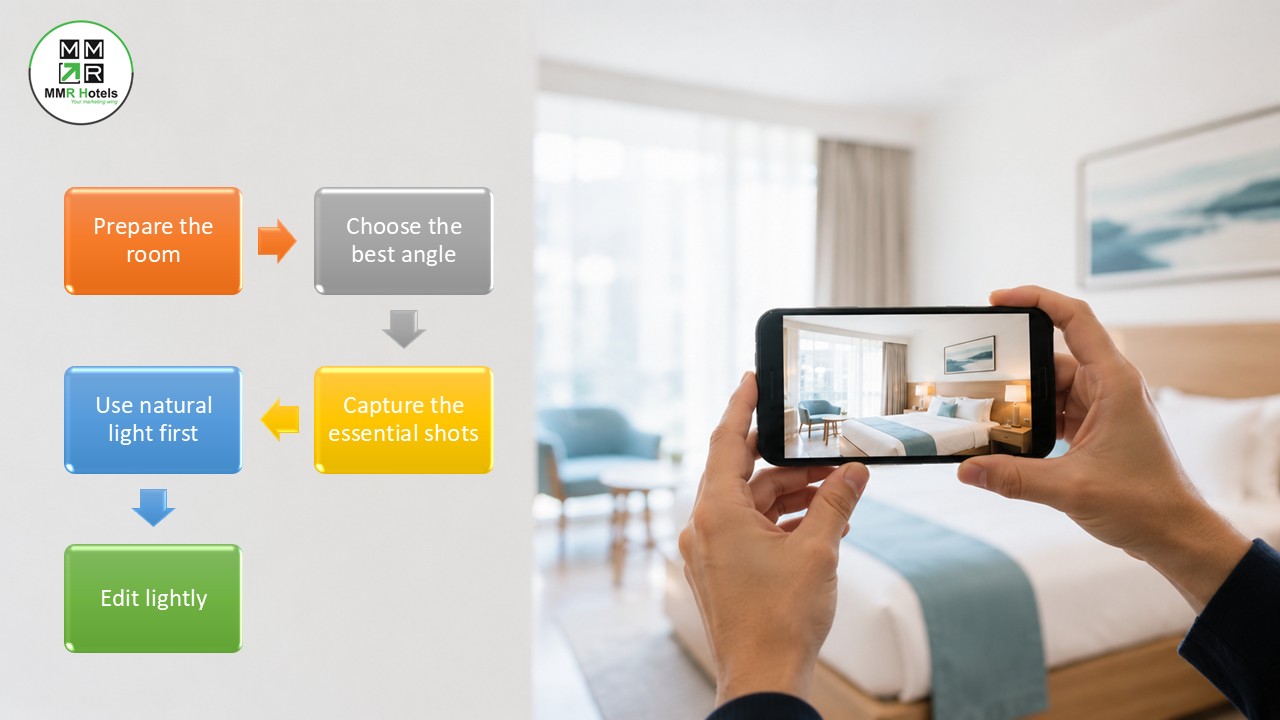
Shooting rooms with curtains drawn and tube lights on. Natural light is the difference between a room that looks fresh and one that looks tired, and it costs nothing. Open the curtains, shoot mid-morning, switch off the yellow bulbs.
Do you need a professional?
For the hero set, yes, in most cases. A hotel photographer with a wide lens and a tripod costs roughly Rs 15,000 to Rs 30,000 for a day in most Indian cities, and that one day of shooting works for two years across every OTA, your website, and your Google Business Profile. Against what a single lost booking a week costs you, the maths is not close.
Phone photos have their place: food shots for a weekend buffet promotion, a quick festival decoration update, the new reception desk. Supplementary, not structural.
The order of operations
Photograph the property clean and staged, not on a turnover day. Shoot every room category, the lobby, dining, washrooms (guests check, always), exterior in daylight, and whatever your one differentiator is, the rooftop, the garden, the view. Upload at full resolution, map to room types carefully, set the hero deliberately, then check the listing on a phone the way a guest sees it.
- 1Audit your current setOpen your own listing on a phone. Count photos, check room-type mapping, judge the hero honestly.
- 2Book one shoot dayRs 15,000 to 30,000, staged rooms, natural light, every category covered.
- 3Get the full listing reviewedMMR's revenue audit covers photography alongside pricing and rank, since they fail together.